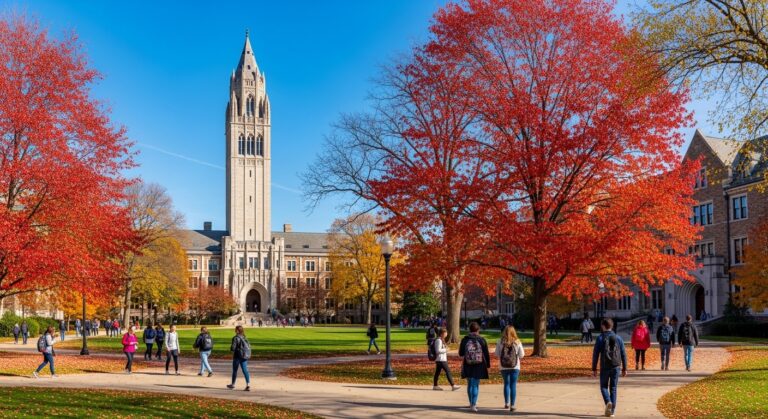
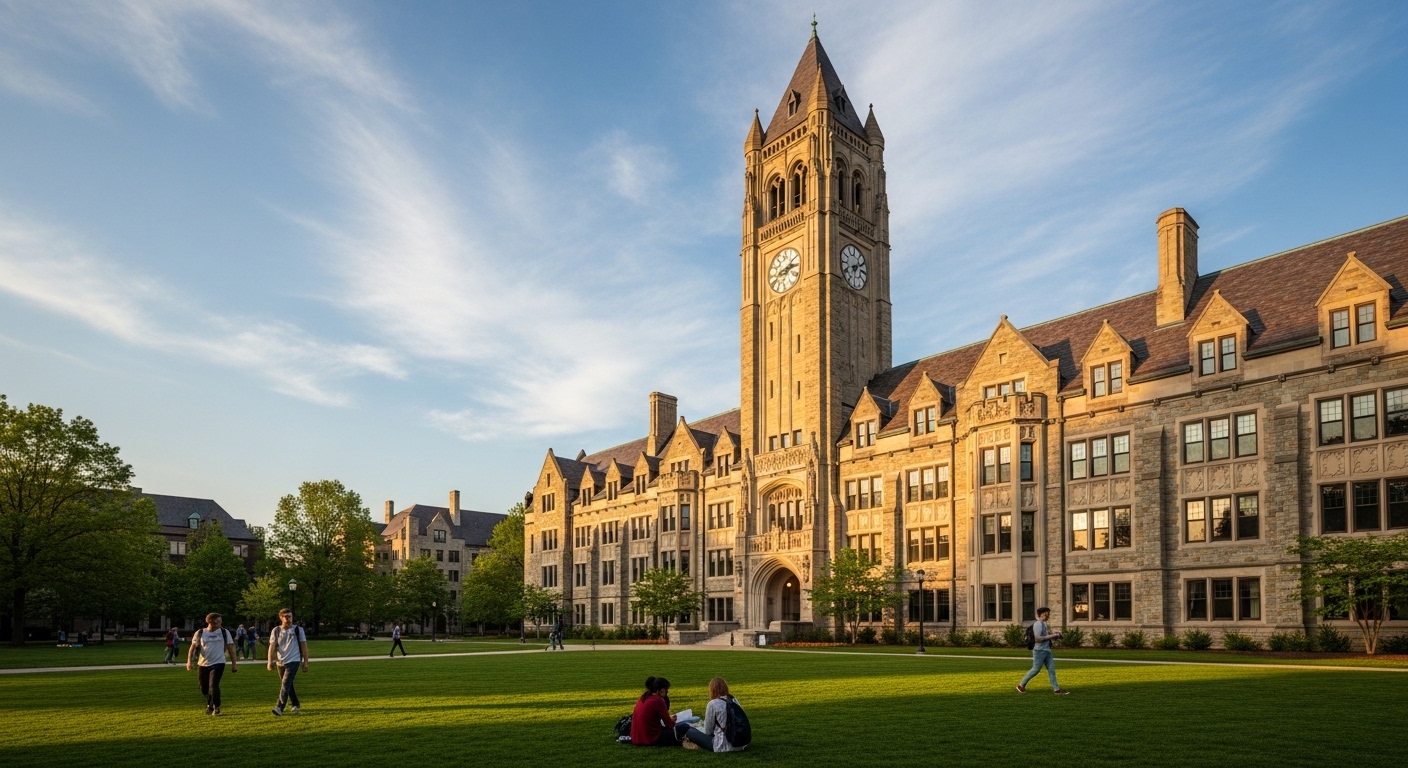
[Washington University in St. Louis] A Complete Parent’s Guide to Your Child’s Admission and Financial Aid at a Top U.S. University
“Can my child get into WashU?”
Many Korean parents say something like this when they talk about Washington University in St. Louis (hereafter, “WashU”):
“I know WashU is a good school, but it’s not Ivy League, right?”
Let me be completely honest. That perception is entirely mistaken.
WashU is already firmly established among the top 20 universities in the United States and is often referred to as the “Harvard of the Midwest.” Its overall acceptance rate is around 12%, and even its Early Decision acceptance rate is only about 25%, making it just as competitive as many Ivy League institutions. With exceptional outcomes in medical school placement, law school placement, and MBA admissions, WashU is not simply “a good school.” It is one of the universities that offers the strongest educational return on investment in the United States.
What is more, WashU operates both a No-Loan policy and need-blind admission review for U.S. citizens and permanent residents. In terms of financial aid, it is one of the very few institutions that can truly stand alongside the Ivy League. And yet, many Korean families fail to seriously consider WashU for one simple reason: name recognition.
In this article, I will share, based on 30 years of experience in the field, a comprehensive guide to WashU admission strategy, a grade-by-grade preparation roadmap, financial aid strategy, and real student case studies. If you read this article to the end, you will understand just how strategically important WashU can be for your child.
1. Key Admissions Analysis for Washington University in St. Louis
What WashU Values Most in Admissions
A close review of WashU’s Common Data Set makes one thing very clear: this university practices true holistic review. It does not merely look at numbers. It evaluates the whole student as a person, from multiple dimensions. The factors officially classified as “Very Important” include the following.
First, the rigor of the secondary school record. What WashU admissions officers look at first is not simply GPA, but how challenging a student’s coursework has been. The key question is whether the student chose the most demanding courses available at their school and performed well in them.
Second, GPA. The average GPA of admitted students is approximately 4.19 weighted, and in practical terms, an unweighted GPA of 3.9 or above is often close to essential. Roughly 65% of admitted students have a weighted GPA of 4.0 or higher, and about 86% rank in the top 10% of their high school class.
Third, essays. In addition to the Common App essay, WashU requires school-specific supplemental essays. These essays are the place where the admissions office asks, “Who are you beyond what numbers can show?” Through the essay, admissions officers hear the student’s voice and gain a direct sense of their intellectual curiosity and values.
Fourth, letters of recommendation. WashU officially classifies recommendation letters as “Very Important.” This is a point many parents overlook. Admissions officers are not simply looking for letters filled with generic praise. What can make a decisive difference is a recommendation that provides concrete examples of the student’s intellectual growth and character.
Fifth, extracurricular activities and leadership. WashU prefers depth of commitment over breadth of participation. Experiences in which a student created meaningful change in a specific area, or made a substantive contribution to their community, can become a powerful point of distinction.
Characteristics of Admitted Students
Over the years, I have observed clear patterns among students admitted to WashU. They are not simply students with “strong credentials.” Of course, their academic level is generally very high. The middle 50% SAT range is around 1500–1570, and the ACT range is 33–35. But those numbers are only the entry ticket, not the letter of admission.
The students WashU wants are those who demonstrate genuine passion in a particular field. The university values students who combine humanistic insight with scientific thinking, or who show unusual depth in one area. WashU wants students who can clearly explain not only what they want to study in college, but why they want to study it.
WashU is also a university deeply connected to the St. Louis community. It welcomes students who show social impact, respect for diversity, and a sincere commitment to contributing to a community. Students who have not merely accumulated community service hours, but have actually created meaningful change, are at an advantage.
Common Misunderstandings Among Korean Parents
Misunderstanding #1: “Isn’t WashU a public university?”
Absolutely not. WashU is a fully independent private research university. Because of the word “Washington” in its name, many parents confuse it with the University of Washington or George Washington University in Washington, D.C. WashU is completely separate from those institutions and is an elite research university on par with the Ivy League.
Misunderstanding #2: “Since it’s not Ivy League, it must be weaker for employment.”
That is incorrect. WashU has some of the strongest graduate school placement rates in the country in medicine, law, business, engineering, and the social sciences. In particular, it is widely known for outstanding medical school placement, and the WashU School of Medicine is consistently ranked among the top 1–5 medical schools in the United States. The median salary for WashU graduates six years after graduation is approximately $78,000, which is extremely strong.
Misunderstanding #3: “It’s already too late. My child is in 11th grade and not prepared.”
It may be late, but it is not impossible. With the right direction, students can absolutely begin serious preparation in 11th grade and still be admitted. In fact, I have worked with multiple students who began focused preparation in the spring of 11th grade and were later admitted to WashU.
Misunderstanding #4: “If my child doesn’t have a 1600 SAT, they shouldn’t even apply.”
That is simply not true. WashU has a test-optional policy, so students can apply without submitting scores if their scores are not strong enough. In fact, only about 29% of applicants submit SAT scores, and about 28% submit ACT scores. The rest apply without scores.
Misunderstanding #5: “If you apply Early Decision, you will receive less financial aid.”
This is also a misunderstanding. WashU provides the same need-based aid to ED applicants, and merit scholarship review is conducted in the same way. The only real drawback is that because ED is binding, families have less flexibility to compare financial aid offers in advance.
2. WashU SAT / GPA / AP Strategy
Target SAT Score Range
Let me be very candid. WashU currently has a test-optional policy. But that does not mean testing is unimportant.
Among students who submit scores, the middle 50% SAT range is 1500–1570, with the top 25% scoring 1570 or above. The ACT range is 33–35. My recommended targets are as follows:
- SAT 1560 or above: Places a student in a very strong position among top applicants
- SAT 1530 or above: Clearly strengthens the application
- SAT 1500 or above: Worth submitting and competitive
- SAT 1480 or below: Consider using the test-optional policy and make sure the application is clearly strong in other areas
- ACT 33 or above: Worth submitting, and a 35 is especially powerful
An important point is that WashU uses superscoring. In other words, if a student takes the exam multiple times, the university combines the highest section scores into a new highest composite. For that reason, a strategy of taking the test two or three times can be very effective.
GPA Strategy
WashU evaluates both unweighted GPA and course rigor. Choosing only easy classes to protect GPA can actually hurt a student.
The ideal combination is earning A’s in challenging courses. If a school offers AP Calculus BC and a student takes only Regular Calculus instead, admissions officers will notice that immediately. The key is to take the most rigorous courses available at the school while maintaining the highest grades possible.
If forced to choose, earning a B+ in a very rigorous class can sometimes be better than earning an A in an easy class. That said, this decision depends on the student’s individual circumstances and should be approached carefully. One principle is very clear: an accumulation of grades below B becomes risky.
AP, Honors, and Dual Enrollment Strategy
There are certain AP courses that WashU values especially highly. These vary depending on a student’s intended major, but they can generally be organized as follows.
For STEM-oriented students
Required: AP Calculus BC, AP Physics C (Mechanics & E&M), AP Chemistry, AP Biology
Strongly recommended: AP Computer Science Principles or AP Computer Science A, AP Statistics
Differentiators: AP Research, AP Environmental Science
For humanities/social sciences-oriented students
Required: AP English Language & Composition, AP English Literature, AP U.S. History, AP World History
Strongly recommended: AP Economics (Micro/Macro), AP Psychology, AP Government
Differentiators: AP Art History, AP Human Geography, AP Seminar (Capstone)
For students interested in business / Olin Business School
Required: AP Calculus AB or above, AP Statistics, AP Economics (Micro/Macro)
Strongly recommended: AP Computer Science, AP English Language
Differentiators: Dual Enrollment economics/business courses connected to leadership activities
In general, a total of about 8–12 AP/Honors courses across high school is considered competitive. However, more important than the number is the connection between those courses, the student’s interests, and the intended field of study.
Dual Enrollment can be an excellent alternative for students in schools where AP offerings are limited. WashU considers a student’s environment and opportunities, so what matters is that the student has pursued the highest level available within their school context.
Timing for Test Preparation and Balancing Activities
The timeline I generally recommend is this: begin more focused PSAT preparation in the spring of 10th grade, then aim for National Merit Semifinalist status through the PSAT/NMSQT in the fall of 11th grade. While WashU does not directly provide a National Merit scholarship, that title can still strengthen an application. The first official SAT attempt should ideally be in the spring of 11th grade, usually March or May. If the student does not reach the target score, retesting in the summer after 11th grade or in the fall of 12th grade, such as August or October, is a good strategy.
Because WashU uses holistic review, meaningful activities and leadership must support the application even if test scores are not perfect. A balanced schedule—such as one hour of SAT study per day while devoting the rest of the time to academics and activities—is usually the most effective approach.
3. Grade-by-Grade Preparation Strategy
Middle School (Grades 6–8): The Season of Planting Seeds
Some parents may wonder, “Do we really need to start preparing in middle school?” But for families aiming for WashU, middle school is an important foundation-building period. The habits and direction established during these years shape the entire high school experience.
Academically, the math track should be designed strategically. If a student completes Algebra I by 8th grade, they can enter an Honors/AP math pathway more naturally in high school. That decision can ultimately determine whether AP Calculus BC becomes possible later on. In English, this is the time to steadily build reading volume and develop the habit of critical reading, which forms the foundation for later essay writing.
In terms of activities, this is the season of exploration. Students should try a range of fields—sports, music, coding, service, debate, science olympiad, and more—in order to discover what they genuinely enjoy. Interests found during this period often grow into meaningful long-term activities in high school.
As for habits, developing self-directed study skills, time management, and organizational habits in middle school can make an enormous difference once high school begins.
9th Grade: A Year to Build the Right Foundation
Grades earned in 9th grade count toward the high school GPA. Students cannot afford to relax from the beginning. WashU admissions officers certainly look at first-semester 9th grade grades.
Academics: Students should take challenging classes from the start, such as Honors English, Honors Math (for example, Honors Geometry or Algebra II), and Honors Science (Biology or Chemistry). Strong performance in world history or geography is also important. Starting with rigorous courses early helps create a natural pathway into AP courses later.
Testing: It is still too early for heavy SAT preparation. However, increasing reading volume and building vocabulary are excellent indirect preparation. Developing a steady habit of learning vocabulary through books or apps can be helpful.
Activities: Students should begin participating in two or three activities with focus. They can join clubs and begin community service. Since WashU values community service, this is the time to plant those seeds. The key is not to accumulate hours mechanically, but to find service experiences that feel genuine.
Leadership: It is not necessary to hold a leadership position in 9th grade. The priority should be consistent participation and earning trust. That trust becomes the foundation for leadership roles in 10th and 11th grade.
10th Grade: The Pivotal Year for Direction
I often call 10th grade the strategic turning point. The choices made during this year shape the direction of 11th and 12th grade. If a student is targeting WashU, this is the year to define both academic direction and extracurricular focus.
Academics: Begin taking one or two AP courses. Good starting points include AP World History, AP Chemistry, AP English Language, and AP Human Geography. Continue strong performance in Honors math and science. Maintaining A’s every semester is critically important.
Testing: Take the PSAT in October. This provides the baseline score. Analyze the results, identify weaknesses, and address them intentionally. Preparation for the 11th grade PSAT/NMSQT should also begin.
Activities: The exploration stage should begin to close, and the student should start investing more deeply in two or three core activities. Summer opportunities such as academic programs, internships, or research should be explored. Students can also begin building demonstrated interest by participating in WashU-related programs or events.
Leadership: This is the time to begin taking on mid-level leadership roles, such as vice president of a club or project leader. These positions can later develop into top leadership roles in 11th grade.
11th Grade: The Year That Decides Almost Everything
To be frank, 11th grade is the hardest year and also the most important. It would not be an exaggeration to say that this one year determines 80% of the college application.
Academics: Students should take three to five AP courses, balancing those aligned with the intended major and those that build a broader academic foundation. First-semester grades are especially important. For students applying ED I to WashU, first-semester senior grades may matter as well, but the full 11th grade record carries the greatest weight.
Testing: Take the SAT in March or May. If the target score is not reached, use the summer for concentrated preparation and retest in August. AP exams are taken in May, and students should aim for scores of 4 or higher. WashU often grants college credit for AP scores of 5.
Activities: Students should secure leadership roles in their core extracurriculars. Ideal roles include club president, team captain, or project founder. During the summer, they should pursue meaningful internships, research, or service projects. Community service, which WashU values highly, should continue with sustained commitment and visible impact.
Application preparation: Finalize the college list. Plan a WashU campus visit. Identify teachers who may write recommendations. Begin essay brainstorming in the spring of 11th grade.
12th Grade: The Year of Execution and Completion
12th grade is the year of execution. Rather than beginning something entirely new, students should focus on presenting everything they have built in the strongest possible way.
Academics: Students must continue taking the most rigorous courses available. Senior slump must be avoided at all costs. WashU reviews final grades even after admission, and a significant decline can result in an offer being rescinded.
Applying Early Decision to WashU: WashU offers two rounds of Early Decision: ED I, with a November 3 deadline, and ED II, with a January 2 deadline. Because ED is binding, an admitted student must enroll. However, since the ED acceptance rate—approximately 25–26%—is much higher than the Regular Decision rate of about 8%, students who truly consider WashU their first choice should strongly consider applying ED. In fact, for the Class of 2029, about 61% of the incoming class was admitted through ED, which shows just how heavily WashU relies on this round.
Essays: Students must complete both the Common Application essay and the WashU supplemental essays. The WashU supplements are a critical opportunity to demonstrate fit. In particular, the “Why WashU?” essay should not read like a generic school description. It should show sincerity through concrete references to professors, programs, research labs, or courses that connect directly to the student’s interests.
4. Real Student Case Studies
Case 1: Student K, Who Realized That Strong STEM Ability Alone Was Not Enough
Student K was someone I began working with in 10th grade. When we first met, he was already an outstanding STEM student: SAT 1560, GPA 4.1 (UW), AP Chemistry score of 5, AP Calculus BC score of 5. On paper, there was very little to criticize.
The problem was that his application had no story. His activities list included math olympiad, science competitions, and coding club, but his involvement in each was shallow. His essay was essentially a statement that he studied hard and wanted to attend a good university. His application was a list of credentials, not the story of a person.
Together, we redesigned his strategy. We discovered that his genuine area of interest was environmental engineering, and we developed a project in which he analyzed water pollution in a local stream. Working with a school teacher, he collected actual water quality data and submitted a report to a local environmental organization. That small project became his story.
His essay changed completely. It became an honest reflection on how, in chasing perfect scores, he had lost sight of what he truly cared about. His passion for environmental protection, along with specific references to WashU’s environmental engineering program and relevant research labs, gave the essay life.
Result: Admitted to WashU ED I.
Numerically, Student K was already among the strongest WashU applicants, but without a compelling story, admission would have been far less likely. The lesson I took from this case is simple: credentials may be the entry ticket, but story is what earns admission.
Case 2: Student M, Who Started Late but Found the Right Direction
Student M first came to me after finishing the first semester of 11th grade. Her question was simple: “Is it already too late?” Her GPA was 3.75 (UW), around average for a competitive applicant, and she had scored 1430 on her first SAT. She had participated in multiple activities, but all at a surface level.
We built a strategy. First, we made her second-semester 11th grade grades the highest priority. We set a target of a 4.0 for that term and focused intensively on weaker subjects. At the same time, we created a plan to raise her SAT to 1520 through concentrated summer preparation.
We also completely reworked her activity strategy. She was already volunteering at a local hospital. We examined that experience more deeply and identified a language barrier between Korean-speaking elderly patients and medical staff who did not speak Korean. In response, she worked with the hospital to design and run a Korean-language medical interpretation volunteer program. It began small, but within three months, she had recruited five volunteers and helped formalize the program.
Her essay centered on the story of finding direction late. It described how she moved from being consumed by numbers and competition to discovering the fulfillment that comes from creating real social impact.
Result: Admitted to WashU through Regular Decision, with a partial merit scholarship.
Her case shows that it is never wise to give up simply because one started late. With the right direction, a meaningful turnaround is entirely possible.
5. Financial Aid and Scholarship Strategy
Need-Blind Policy for Domestic Students
WashU practices need-blind admissions for first-year applicants who are U.S. citizens or permanent residents. In other words, a student’s financial circumstances do not affect the admission decision. Applying for financial aid does not place a student at a disadvantage.
However, for international students, WashU follows a need-aware policy. In those cases, a student’s financial need may influence the admission review. That said, WashU still offers need-based financial aid to first-year international students, and international students may also apply to programs such as Danforth Scholars and Rodriguez Scholars.
100% of Demonstrated Need Met + No-Loan Policy
WashU meets 100% of demonstrated financial need for all admitted students. Beyond that, it follows a No-Loan policy, which means student loans are not included in the financial aid package. Instead, packages are composed of grants, scholarships, and work-study.
According to U.S. News 2026, WashU’s annual total cost exceeds $93,000, including tuition of $69,594 and room and board of $23,338. The average need-based aid package is approximately $77,091. This is an exceptionally generous level of support, even by national standards.
Required Financial Aid Documents
- FAFSA (Free Application for Federal Student Aid) — School Code: 002520
This is the basic federal financial aid document. - CSS Profile — School Code: 1922
WashU uses the CSS Profile to understand family finances in greater detail. This form serves as the basis for institutional aid. - Tax documents such as the W-2 and 1040 are also required as supporting materials.
ED I applicants must submit financial aid documents by November 15, and Regular Decision applicants must submit them by January 25.
Merit-Based Scholarships: Signature Scholar Programs
WashU has several merit-based scholarship programs that families should pay close attention to: the Signature Scholar Programs. These scholarships are not based solely on grades and scores. They place strong emphasis on service, leadership, and commitment to diversity. Korean parents, in particular, should make sure they understand these opportunities.
- Danforth Scholars Program: Full or half tuition scholarship. Intended for students who demonstrate community service leadership, moral character, and intellectual creativity. A separate scholarship application is required, with a deadline of January 3.
- Ervin Scholars Program: Full or partial scholarship. Based on four pillars: academic excellence, leadership, community service, and diversity. Open only to U.S. citizens and permanent residents. A separate application is required.
- Rodriguez Scholars Program: For students who are committed to community service and leadership that brings diverse groups together. International students may also apply.
These scholarships require separate applications, and finalists must participate in a series of events, including virtual interviews. Because the scholarship deadline of January 3 is different from the general admission deadline, families must pay close attention.
Aid Strategy by Estimated Family Income
- Income below $75,000: Most of tuition is likely to be covered through grants and scholarships. The family’s out-of-pocket cost may be very low or close to zero.
- Income between $75,000 and $150,000: Substantial need-based aid can often be expected. Accurate reporting of assets through the CSS Profile is especially important.
- Income between $150,000 and $250,000: Some assistance may still be possible. Aid can increase if more than one child is in college at the same time.
- Income above $250,000: Need-based aid may be limited, but families should still apply, especially if there are special circumstances such as major medical expenses.
Important Points Korean Parents Often Miss
First, some families do not take the CSS Profile seriously enough. If they submit only the FAFSA and skip the CSS Profile, they may lose access to institutional aid. Both forms must be submitted.
Second, many families miss the Signature Scholar Programs deadline. The Regular Decision admission deadline is January 2, while the scholarship deadline is January 3. Since they are not the same, families must be careful.
Third, some families fail to report assets in Korea. Real estate or financial assets held in Korea must also be reported honestly on the CSS Profile. Omissions can create serious problems later.
Fourth, some families do not use the Net Price Calculator. Families should estimate their expected contribution in advance through WashU’s official Net Price Calculator or the simplified MyinTuition calculator.
6. Application Preparation Checklist
Essential Preparation in 11th Grade
- Take 3–5 AP courses and maintain A’s
- Take the first SAT/ACT (March or May)
- Take the PSAT/NMSQT in November (for National Merit consideration)
- Secure leadership roles in core activities
- Participate in a summer program, internship, or research project
- Visit the WashU campus or attend a virtual tour to build demonstrated interest
- Identify two teachers for recommendations and ask them in advance
- Create a first version of the college list (Reach / Match / Safety)
- Begin essay brainstorming before summer
- Draft an activities list
- Review the Signature Scholar Programs and build an application strategy
Essential Preparation in 12th Grade
- September: Create a Common Application account and enter basic information
- September–October: Complete and revise the WashU supplemental essays multiple times
- After October 1: Begin FAFSA and CSS Profile
- October: Final SAT/ACT attempt, if needed
- November 1: Submit ED I application if WashU is the clear first choice
- November 15: Financial aid deadline for ED I applicants
- January 2: ED II or Regular Decision application deadline
- January 3: Signature Scholar Programs deadline
- January 25: Financial aid deadline for Regular Decision applicants
Recommendations: At least two letters, ideally one from an English/humanities teacher and one from a math/science teacher
Activities list: Arrange the 10 activity entries strategically by impact
“Why WashU?” essay: Mention specific programs, professors, and courses
Interview: WashU does not offer official interviews, so the essays must do the work of fully presenting the student
7. Practical Advice
Common Mistakes Made by Parents and Students
Mistake #1: Underestimating the strategic value of ED.
If WashU is truly the student’s first choice, applying RD instead of ED means giving up the biggest opportunity voluntarily. The difference between an ED acceptance rate of about 25–26% and an RD acceptance rate of about 8% is more than threefold. Of course, because ED is binding, families should understand the likely financial aid outcome in advance. But given WashU’s No-Loan policy and commitment to meeting 100% of demonstrated need, it is often well worth serious consideration.
Mistake #2: Writing a generic “Why WashU?” essay.
One of the most important WashU supplements is the essay that demonstrates sincere interest in the university. Answers such as “Because WashU is a great school” leave no impression. Students should mention specific professors, labs, courses, or distinctive programs, and explain clearly how those connect to their own interests.
Mistake #3: Focusing only on the breadth of activities.
It is far more powerful to create meaningful change in two or three activities than to list ten clubs without depth. WashU does not want an application that is “a mile wide and an inch deep.”
Mistake #4: Overlooking the Signature Scholar Programs entirely.
These programs offer extraordinary full-tuition opportunities for students with genuine strength in service and leadership. The application deadline is January 3, and separate 250-word essays are required. Too many students miss this opportunity simply because they never knew it existed.
Strategy for Students Who Started Late
Parents often ask me, “My child is already in 11th grade. Can we still start now?” I have heard this question for 30 years. My answer is always the same: it may be late, but it is not impossible.
Students who begin in 11th grade should focus on the following. First, make 11th grade first- and second-semester grades as strong as possible. An upward trend in recent grades matters. Second, go deeper in activities the student is already doing and produce something meaningful from them. Rather than starting many new activities, maximize the impact of existing ones. Third, use the summer fully. Concentrated SAT preparation, one meaningful project, and a first draft of the essays can all move forward at the same time. Fourth, use the essay to tell a growth story. A narrative built around “I realized it late, but that realization changed me” can become a very powerful essay.
The Parent’s Role
In my 30 years of experience, the most effective parents are not managers, but supporters. They prepare financial aid documents in advance, help keep track of deadlines, and provide emotional support when their child is struggling. They may visit campuses with their child, but still give the student room to feel, think, and decide independently.
There are also certain things parents should never do: write the essay for the student, over-edit it, choose and control the student’s activities, or compare their child to “the student next door.” Admissions officers are remarkably good at recognizing essays that have been shaped too heavily by parents. The student’s own voice must remain alive.
The Balance Between Private Support and Student Ownership
In U.S. college admissions, outside support is only a tool. It is not the answer in itself.
An SAT academy may help raise a student’s score, but it cannot create genuine passion in activities or authenticity in an essay.
The best balance looks like this: students may receive professional support for standardized tests such as the SAT or ACT, but they should lead and own their activities. They may receive expert guidance during the brainstorming stage of essay writing, but the actual writing must remain in the student’s own voice. The overall admissions strategy may be designed with an experienced professional, but the student must always remain the central actor in the process.
8. Final Thoughts: The Journey to WashU Begins Today
To the parents reading this article, if you are wondering whether WashU may be too ambitious a dream for your child, I would ask you to remember just one thing.
A 12% acceptance rate can certainly feel intimidating. But when a student applies Early Decision, the acceptance rate rises to over 25%. And the students who fall within that 25% all once had the same doubts. What made the difference was not inborn talent. It was time spent preparing consistently in the right direction.
WashU is not simply looking for students who earn high grades. The university is seeking students who combine academic excellence with social responsibility, commitment to community, and a desire to make the world better. If your child already has these qualities, then the admissions process is really about discovering them, developing them, and expressing them clearly.
WashU is also an exceptionally attractive institution financially. Its need-blind policy, commitment to meeting 100% of demonstrated need, No-Loan packages, and full-scholarship opportunities through the Signature Scholar Programs make it one of the very few universities in the United States that offers this level of financial support.
Most importantly, success requires long-term strategy. Starting in middle school is ideal, and students in 9th or 10th grade still have plenty of time. Even students already in 11th grade should not give up. At every stage, what matters most is having the right strategy for the student’s individual circumstances.
Over the past 30 years, I have had the privilege of helping many students gain admission to their dream schools. Through that process, I have learned one clear truth: the earlier the preparation, and the more precise the strategy, the more the outcome can change.
Would you consider beginning your child’s WashU journey today? Designing a personalized roadmap with an experienced professional may be the most reliable first step.
Thank you.
Andy Lee / Elite Prep Suwanee
1291 Old Peachtree Rd. NW #127
Suwanee, GA 30024
Email: andy.lee@eliteprep.com
Website: www.eliteprep.com/suwanee
Tel & Text: 470.253.1004