University of Florida- A Parent’s Complete Guide to U.S. College Admissions & Financial Aid
Hello, parents. This is Andy Lee from Elite Prep Suwanee, where our Summer 2026 SAT Bootcamp is officially recognized as a college-approved AP course — a program designed to help your student’s high school GPA climb meaningfully while preparing for the SAT.
“Is the University of Florida really a strong school? Does my child have a realistic shot at getting in?”
This is one of the most common questions I have received from Korean-American parents over the past three decades. The University of Florida (UF) is one of the finest public research universities in the country, and it is particularly well known for delivering exceptional educational value relative to its cost. Many Korean-American families have not yet fully appreciated what UF truly offers, and this guide is written to change that.
UF is far more than simply an “affordable public university.” From undergraduate instruction to graduate-level research, the institution operates at the highest tier, with engineering, business, and journalism programs consistently ranking among the nation’s top ten. Even more importantly, UF graduates compete on equal footing with their private-school peers when it comes to post-graduation employment outcomes and starting salaries.
1. Fast Facts
| Category | Details |
| Founded | 1853 |
| Location | Gainesville, Florida |
| Total Enrollment | Approximately 52,000 (35,000 undergraduates) |
| Student-to-Faculty Ratio | 18:1 |
| Campus Size | 2,000 acres |
| Mascot | Gators (Albert and Alberta) |
| School Colors | Orange and Blue |
Founded in 1853, the University of Florida is the flagship institution of the state of Florida. It began its life as the East Florida Seminary and was formally renamed the University of Florida in 1906. After a period of rapid expansion beginning in the 1950s, UF has grown into one of the largest public universities in the United States.
| Andy’s Insight UF is widely classified as a “Public Ivy,” a select group of public institutions that deliver a private-school caliber of education at public-school tuition. It is one of only a handful of universities that can credibly make that claim. |
2. Rankings
Overall University Rankings (2024)
| Publication | Ranking | Category |
| U.S. News – National Universities | #28 | National |
| U.S. News – Public Universities | #5 | Public |
| WSJ / Times Higher Education | #47 | National |
| Forbes | #53 | America’s Top Colleges |
| Niche | #42 | Best Colleges in America |
Rankings by Major Field of Study (2024)
| Program | Ranking | Notable Distinctions |
| Business (Warrington College) | #15 | Finance #5 · Real Estate #1 |
| Engineering | #23 | Aerospace #11 · Agricultural #7 |
| Journalism | #6 | Sustained top-ten ranking |
| Education | #18 | Strength in special education |
| Medicine | #45 | Primary Care ranked #32 |
| Law | #32 | Top-5 nationally in Tax Law |
| Veterinary Medicine | #9 | Among the best in the nation |
| Agriculture | #8 | Home to the IFAS research institute |
3. Leading Colleges and Schools
Warrington College of Business
The premier business school in the state of Florida, with a Real Estate program that ranks #1 in the country. Its integration with the Fisher School of Business has produced an even more powerful and comprehensive program offering.
Herbert Wertheim College of Engineering
Home to nationally top-ten programs in aerospace and agricultural engineering, the college is particularly recognized for its emphasis on applied, real-world research projects.
College of Journalism and Communications
Ranked #6 nationally, this college maintains a sterling reputation and has sent a steady stream of graduates to major media organizations including CNN and ESPN.
College of Agricultural and Life Sciences
A national leader in the agricultural and life sciences, anchored by the Institute of Food and Agricultural Sciences (IFAS).
College of Medicine
Established in 1956, UF’s medical school delivers top-tier clinical education in close partnership with UF Health.
College of Veterinary Medicine
Ranked #9 nationally, the college provides a comprehensive curriculum spanning small-animal through large-animal practice.
4. Admissions
Admissions Statistics (2023)
| Metric | Figure |
| Total Applicants | 62,000 |
| Admitted Students | 11,500 |
| Acceptance Rate | 19% |
| Enrolled Students | 7,200 |
| Yield Rate | 63% |
Admitted Student Academic Profile (2023)
| Metric | 25th Percentile | 75th Percentile |
| SAT Total | 1350 | 1470 |
| SAT Math | 660 | 750 |
| SAT ERW | 650 | 720 |
| ACT Composite | 30 | 34 |
| GPA (Weighted) | 4.4 | 4.6 |
| GPA (Unweighted) | 3.8 | 4.0 |
| A Word of Caution UF’s acceptance rate has fallen sharply in recent years — from 39% in 2018 to 19% in 2023. The university now demands a genuinely competitive application and should no longer be regarded as a “safety” school. |
Application Timeline (2024–2025)
| Application Type | Deadline | Decisions Released |
| Early Action | November 1 | Mid-February |
| Regular Decision | January 15 | — |
| FAFSA (priority) | October 1 | — |
Essay Requirements
1. Personal Essay (650 words)
Applicants select one prompt from the seven options available on the Common Application.
2. UF Supplemental Essays (250 words each)
- Tell us about a meaningful contribution you have made, or one you plan to make.
- Describe a personal quality, talent, accomplishment, contribution, or experience.
- What makes you unique, or sets you apart from other candidates?
| Andy’s Tip UF’s supplemental essays are relatively direct when compared with those of other selective universities. The key is to articulate the applicant’s passion and the tangible contributions they have made — with clarity and specificity. |
5. Cost of Attendance and Financial Aid
Cost of Attendance (2023–2024)
| Category | Florida Residents | Out-of-State / International |
| Tuition | $6,380 | $28,658 |
| Housing | $11,450 | $11,450 |
| Meal Plan | $5,700 | $5,700 |
| Books & Supplies | $1,000 | $1,000 |
| Personal Expenses | $3,000 | $3,000 |
| Total Cost | $27,530 | $49,808 |
Financial Aid Programs
Merit-Based Scholarships
- Presidential Scholars Program: a full four-year scholarship awarded to the university’s top-ranked admitted students.
- University Scholars Program: $4,000 to $8,000 per year.
- Florida Academic Scholars: the Bright Futures scholarship, available to eligible Florida residents.
- National Merit Scholarships: awarded to National Merit Finalists.
Need-Based Aid
- Average need-based award: $8,500.
- Percentage of students whose financial need is fully met: 88%.
- Average debt at graduation: $21,500.
| Financial Aid Tip Among public universities, UF offers a notably generous financial aid package. For Florida residents in particular, combining in-state tuition with the Bright Futures scholarship can bring the net cost of attendance close to zero. |
6. Campus Life
Location and Environment
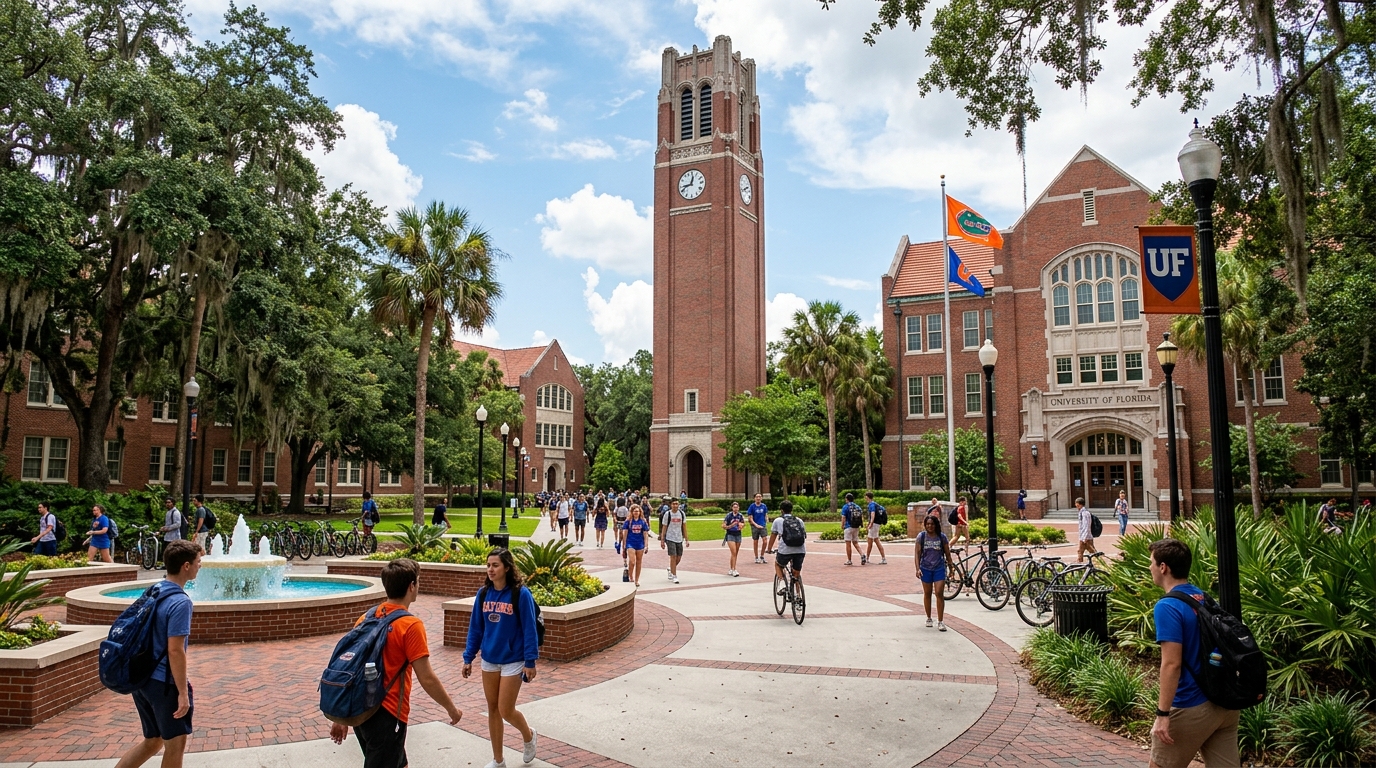
The University of Florida is located in Gainesville, a city in north-central Florida. Gainesville is a quintessential college town, and a substantial share of its population is connected to the university in one way or another. The campus itself spans 2,000 acres, pairing a beautiful natural setting with thoroughly modern academic and residential facilities.
Signature Buildings and Facilities
- Century Tower: the university’s 157-foot iconic bell tower.
- Ben Hill Griffin Stadium (“The Swamp”): an 88,548-seat football stadium.
- Marston Science Library: the university’s dedicated library for science and technology.
- Reitz Union: the hub of student life and activity on campus.
- UF Health: a state-of-the-art medical complex and teaching hospital.
Student Life
Clubs and Organizations
- More than 1,000 recognized student organizations.
- Over 50 Greek Life organizations.
- Pre-professional societies and academic clubs across every discipline.
- A wide range of service and community-engagement groups.
Athletics
- Member of the Southeastern Conference (SEC).
- Football: three national championships (1996, 2006, 2008).
- Basketball: two NCAA championships (2006, 2007).
- Baseball: 2017 College World Series champions.
- An additional 20 NCAA Division I varsity sports.
Residential Life
Approximately 70% of UF’s first-year students live in on-campus housing. The university offers several distinct residence hall styles, giving students real flexibility in choosing a living arrangement that fits them.
| Housing Type | Key Features | Cost per Semester |
| Traditional | Two-person rooms, shared bathrooms | $4,500 |
| Suite-Style | Four students share two bedrooms and a private bath | $5,200 |
| Apartment-Style | Four-person apartments with a full kitchen | $6,000 |
7. Career Outcomes
Employment Statistics (Class of 2023)
| Metric | Rate / Figure |
| Employed within 6 months of graduation | 91% |
| Pursuing graduate study | 22% |
| Average starting salary | $56,000 |
| Mid-career salary (10 years out) | $94,000 |
Leading Employers of UF Graduates
Technology and Industry
- Microsoft, Google, Amazon, Apple.
- JPMorgan Chase, Bank of America, Wells Fargo.
- Disney, Universal Studios.
- Procter & Gamble, Johnson & Johnson.
- Lockheed Martin, Boeing.
Healthcare and Life Sciences
- UF Health.
- Mayo Clinic.
- Cleveland Clinic.
- Pfizer, Merck.
Media and Communications
- CNN, ESPN, Fox Sports.
- The New York Times, The Washington Post.
- NBC, CBS, ABC regional affiliates.
Average Starting Salary by Major
| Field of Study | Average Starting Salary |
| Computer Science | $75,000 |
| Engineering | $68,000 |
| Business | $58,000 |
| Journalism | $42,000 |
| Education | $48,000 |
| Career Services UF’s Career Connections Center partners with more than 2,000 employers each year, opening up a broad pipeline of internships and full-time opportunities for students across every discipline. |
8. Five Common Misconceptions Among Korean-American Parents
Misconception 1: “As a public university, the quality of education must be lower.”
Reality: UF is classified as a Public Ivy. Its faculty credentials and research output match those of the top private universities, and the institution is home to Nobel laureates and other internationally recognized scholars.
Misconception 2: “It is a safe, easy-to-get-into school.”
Reality: With a 2023 acceptance rate of 19%, UF is genuinely competitive. The rate is higher than that of UC Berkeley (11.4%) or UCLA (8.6%), but the bar for admission is still meaningfully high.
Misconception 3: “Because it is in Florida, career opportunities must be limited.”
Reality: UF graduates enjoy strong national brand recognition and are active in Silicon Valley, New York, Washington, D.C., and virtually every other major market.
Misconception 4: “It is likely to be disadvantageous for Asian students.”
Reality: UF places a genuine emphasis on diversity, and Asian students make up roughly 20% of the undergraduate student body — a substantial share. Korean student associations and pan-Asian cultural groups are active and well established on campus.
Misconception 5: “It is a disadvantageous school for those aiming for medical school or law school.”
Reality: UF’s own medical and law schools are both top-tier, and the rate at which UF graduates are admitted to other elite professional schools is likewise strong. The pre-med program consistently places more than 75% of its applicants into medical school.
9. Five Features That Set the University of Florida Apart
1. Gator Nation: One of the World’s Most Powerful Alumni Networks
UF graduates — known universally as Gators — form a 400,000-strong global alumni network. This community is an exceptional resource for employment, internships, and mentorship at every stage of a student’s career.
2. A Rare Balance Between Athletics and Academics
UF is the only university in the United States to hold simultaneous national championships in both football and men’s basketball (2006–2007). Its vibrant athletic culture contributes in a meaningful way to school pride and alumni engagement.
3. An Innovation Hub and Startup Ecosystem
UF is the largest center of technological innovation in the state of Florida. In partnership with Innovation Square, the university offers students robust opportunities to launch their own ventures — and each year sees dozens of new student-founded companies.
4. The Honors Program: A Small Liberal Arts Experience Inside a Research University
The University Honors Program provides the intimate, small-community experience of a liberal arts college inside a major research university. Roughly 1,800 high-achieving students are admitted to the program, where they benefit from distinctive coursework and scholarship support.
5. Year-Round Learning and the Summer B System
UF’s distinctive Summer B calendar allows students to take coursework throughout the entire year. Many students use this flexibility to graduate in three and a half years rather than four, or to pursue a double major without extending their time on campus.
10. Admitted Student Profiles
Profile 1: Korean-American Student J.K.
Academic Record
- GPA: 3.91 (unweighted); 4.52 (fully weighted).
- SAT: 1420 (Math: 720; ERW: 700).
- AP / Honors: 8 AP courses — Calculus BC (5), Biology (5), Chemistry (4), U.S. History (4), English Language (4), Physics 1 (4), Statistics (5), Spanish Language (4) — and 6 Honors courses.
Extracurricular Activities (Grades 9–12)
- National Honor Society (11–12, Secretary).
- Science Olympiad (9–12, Team Captain in 12th grade).
- Hospital Volunteer (10–12, more than 300 hours).
- Math Tutor for local middle school students (11–12).
- Korean Cultural Club (9–12, Vice President in 12th grade).
- Tennis Team (9–10).
- Red Cross Blood Drive Organizer (11–12).
Distinguishing Feature
Over the summer, this student participated in a UF Summer Science Program and completed a biology research project on campus. The experience helped crystallize the student’s interest in UF, and it featured prominently and effectively in the application essay.
Profile 2: Florida Resident Student S.L.
Academic Record
- GPA: 3.88 (unweighted); 4.45 (fully weighted).
- ACT: 32 (English: 34; Math: 31; Reading: 33; Science: 30).
- AP / Dual Enrollment: 6 AP courses — English Literature (4), Calculus AB (4), Environmental Science (5), Psychology (5), Government (4), Art History (3) — and 4 Dual Enrollment courses (College Algebra, English Composition, Sociology, Public Speaking).
Extracurricular Activities (Grades 9–12)
- Student Government (10–12, Class President in 12th grade).
- Debate Team (9–12, State Qualifier).
- Environmental Club (9–12, Founder and President).
- Local Newspaper Internship (11–12).
- Youth Court Volunteer (10–12, more than 150 hours).
- Varsity Swimming (9–11, earned varsity letter).
- Key Club (9–12).
- Part-time employment at the local public library (12th grade).
Distinguishing Feature
Motivated by a deep commitment to environmental stewardship, this student led an original project to implement a recycling program throughout the high school. The initiative was featured in the local newspaper and has since been adopted as a model by neighboring schools.
11. Grade-by-Grade Preparation Strategy
Middle School
- Build a strong foundation in mathematics and the sciences.
- Develop reading habits that cultivate critical thinking.
- Experiment with a range of extracurricular activities.
- Begin accumulating leadership experience.
9th Grade (Freshman Year)
- Recognize the importance of GPA early, and establish strong study habits.
- Enroll in as many Honors courses as feasible.
- Begin participating in clubs aligned with the student’s emerging interests.
- Begin community service work.
- Develop time-management skills.
10th Grade (Sophomore Year)
- Take on the first AP courses (1 or 2 is recommended).
- Prepare for and sit the PSAT.
- Begin pursuing leadership roles within extracurricular activities.
- Consider participating in a summer academic program.
- Explore possible areas of academic interest and potential majors.
11th Grade (Junior Year)
- The most important year — GPA management is the top priority.
- Take on 3–5 AP courses.
- Prepare intensively for the SAT or ACT; sittings in March and May are recommended.
- Consider SAT Subject Tests where applicable.
- Pursue meaningful summer engagement such as research or an internship.
- Develop a preliminary college list.
- Build strong relationships with teachers who will write letters of recommendation.
12th Grade (Senior Year)
- Prepare for Early Action (UF offers only Early Action, not Early Decision).
- Draft and polish application essays.
- Request teacher recommendations (by mid-August).
- Take the SAT or ACT one final time if needed.
- Submit the FAFSA and apply for scholarships.
- Guard against senioritis — sustain strong grades through graduation.
Checklists: 11th and 12th Grade
11th Grade Checklist
- Sit the PSAT / NMSQT in October.
- Take the SAT or ACT for the first time in March.
- Prepare for and sit AP exams in May.
- Apply to summer programs in February or March.
- Begin researching colleges in earnest.
- Cultivate relationships with future recommenders.
- Finalize senior-year course selection.
- Secure leadership positions in key activities.
- Plan any standardized test retakes.
12th Grade Checklist
- Create a Common Application account in August.
- Complete essay drafts by early September.
- Request teacher recommendations by late August.
- Prepare and submit the FAFSA by October 1.
- Submit the UF Early Action application by November 1.
- Arrange for final transcripts to be sent.
- Apply for merit scholarships.
- Confirm enrollment after admission.
- Complete housing selection and course registration.
- Attend the university’s new-student orientation.
Conclusion
The University of Florida is far more than simply a “good public university.” It is a leading research institution in its own right. UF delivers a top-caliber education at a reasonable cost, and its programs in business, engineering, journalism, and medicine are among the very best in the country.
Who Is the Right Fit for UF?
- Students with strong academic records (GPA above 3.8, SAT above 1350).
- Students who want an active, immersive campus life.
- Students who prioritize exceptional value per dollar of tuition.
- Students who actively seek out research opportunities.
- Students who want to experience warm weather and a culturally rich environment.
- Students who want to benefit from a powerful alumni network.
UF is no longer a “safe option.” The 19% acceptance rate makes that clear — but what a successful applicant gains in return is genuinely substantial. For Korean students in particular, UF offers an engaged Asian-American community and a remarkably wide range of cultural opportunities.
If you are seriously considering the University of Florida, I would strongly encourage you to begin preparing in a systematic way as early as possible. Above all else, please take the time to carefully consider whether the student is the right fit for UF’s distinctive culture and environment.
Elite Prep Suwanee
From SAT preparation to financial aid, and AP and college courses approved by universities nationwide — brought to you by Elite Prep Suwanee.
Andy Lee
Director, Elite Prep Suwanee · Powered by Elite Open School
1291 Old Peachtree Rd. NW #127, Suwanee, GA 30024
Phone / Text: 470.253.1004
Email: andy.lee@eliteprep.com
Web: www.eliteprep.com/suwanee