University of Southern California (USC)- A Parent’s Complete Guide to Admission and Financial Aid at a Top U.S. University
Hello, everyone. This is Andy Lee from Elite Prep, where we run our flagship “Summer 2026 SAT Bootcamp” — a program that allows students to prepare for the SAT while simultaneously earning officially recognized Advanced Placement (AP) credit, giving their high school GPA a meaningful boost.
A Question from a Parent
“Mr. Lee, my child is passionate about film and business. What kind of school is USC, and as a private university, how does it handle the cost of attendance and financial aid?”
Andy Lee’s Answer
USC is widely recognized for what it calls the “Trojan Family” — one of the most powerful alumni networks in the country — along with the West Coast’s premier film school and an outstanding business program. The university maintains particularly close ties with California’s entertainment, technology, and business industries, which translates into significant career advantages for its graduates. Tuition is high, but USC’s need-based financial aid is genuinely generous.
| Key takeaway: USC is more than a prestigious university. It is an institution that provides students with lifelong access to the Trojan Network. Its influence on the West Coast and its deep industry partnerships are what truly distinguish USC from its peers. |
1. School at a Glance
| Category | Details |
| Founded | 1880 |
| Location | Los Angeles, California |
| Enrollment | 50,448 total (Undergraduate 20,790; Graduate 29,658 — 2023) |
| Faculty | 4,700 (Student-to-Faculty Ratio 9:1) |
| Campus Size | 226 acres |
| School Colors | Cardinal Red & Gold |
| Mascot | Tommy Trojan |
| Nicknames | USC, Trojans |
USC was founded in 1880 as a research-oriented private university, established through the contributions of Los Angeles citizens. From its earliest days, the university committed itself to a defining principle: rather than serving a small elite, USC would open its doors to every talented student. That founding promise still shapes the institution today. Having grown alongside California’s rapid development, USC is now widely regarded as one of the leading private research universities on the West Coast.
2. Rankings
| Ranking Source | Position (2024) |
| U.S. News National Universities | #28 |
| QS World University Rankings | #116 |
| Times Higher Education | #65 |
| Forbes America’s Top Colleges | #52 |
Rankings by Discipline (U.S. News, 2024)
| Field of Study | Rank |
| Cinema and Media Studies | #1 |
| Business (Marshall) | #12 |
| Engineering (Viterbi) | #10 |
| Communications (Annenberg) | #1 |
| Public Affairs | #4 |
| Architecture | #5 |
3. Major Schools and Colleges
USC School of Cinematic Arts
Widely considered the most renowned film school in the world, USC’s School of Cinematic Arts has produced Hollywood luminaries such as George Lucas and Steven Spielberg. The school offers comprehensive education across every facet of media — film, television, gaming, and interactive media.
USC Marshall School of Business
One of the West Coast’s leading business schools, Marshall is particularly strong in entrepreneurship and marketing, and maintains close working relationships with companies in both Los Angeles and Silicon Valley.
USC Viterbi School of Engineering
Highly regarded in computer science, electrical engineering, and aerospace engineering, Viterbi has also taken a leading role in game development and VR/AR research.
USC Annenberg School for Communication and Journalism
Ranked first nationally in communication and journalism, Annenberg offers an innovative curriculum tailored to the realities of the digital media age.
USC Dornsife College of Letters, Arts & Sciences
USC’s largest college, Dornsife encompasses the full range of foundational disciplines across the humanities, social sciences, and natural sciences.
Keck School of Medicine of USC
Keck serves as USC’s primary academic home for medicine, dentistry, pharmacy, and the broader health professions.
4. Admissions Information
| Admission Plan | Application Deadline | Acceptance Rate |
| Early Action (EA) | November 1 | 9.5% (Fall 2026) |
| Early Decision (ED) | November 1 | 8.5% (Fall 2026) |
| Regular Decision | January 10 | 10.4% (Fall 2026) |
Admitted Student Profile (Class Entering 2023)
| Category | Middle 50% Range |
| SAT Total | 1470–1560 |
| SAT ERW | 720–770 |
| SAT Math | 750–800 |
| ACT Composite | 33–35 |
| GPA (Weighted) | 4.05–4.25 |
Application Essays
USC accepts the Common Application and additionally requires its own institutional supplemental essays:
- Please describe the challenges or circumstances and how they have impacted you. (250 words)
- Please provide any additional information you wish to share. (300 words)
| Important: USC’s School of Cinematic Arts and several specialized programs require additional portfolio submissions or auditions. Be sure to verify the supplemental requirements specific to each major before applying. |
5. Cost of Attendance and Financial Aid
| Category | 2023–2024 Academic Year |
| Tuition | $63,468 |
| Room | $9,434 |
| Board | $6,068 |
| Other Expenses | $4,638 |
| Total Cost of Attendance (COA) | $83,608 |
Financial Aid Policy
USC’s financial aid program is anchored by several distinctive commitments:
- Need-blind admissions: a family’s financial situation does not influence admission decisions.
- 100% demonstrated need met: USC pledges to meet the full demonstrated financial need of every admitted student.
- Families with annual income under $80,000: tuition is fully covered.
- Families with annual income between $80,000 and $120,000: 50% of tuition is covered.
- Average financial aid award: $51,690 (as of 2023).
Major Merit Scholarship Programs
- Trustee Scholarship: full-tuition award (highly selective).
- Presidential Scholarship: half-tuition award.
- Dean’s Scholarship: quarter-tuition award.
- Additional merit-based scholarships are available for high-achieving students across multiple programs.
6. Campus Life
Location and Campus
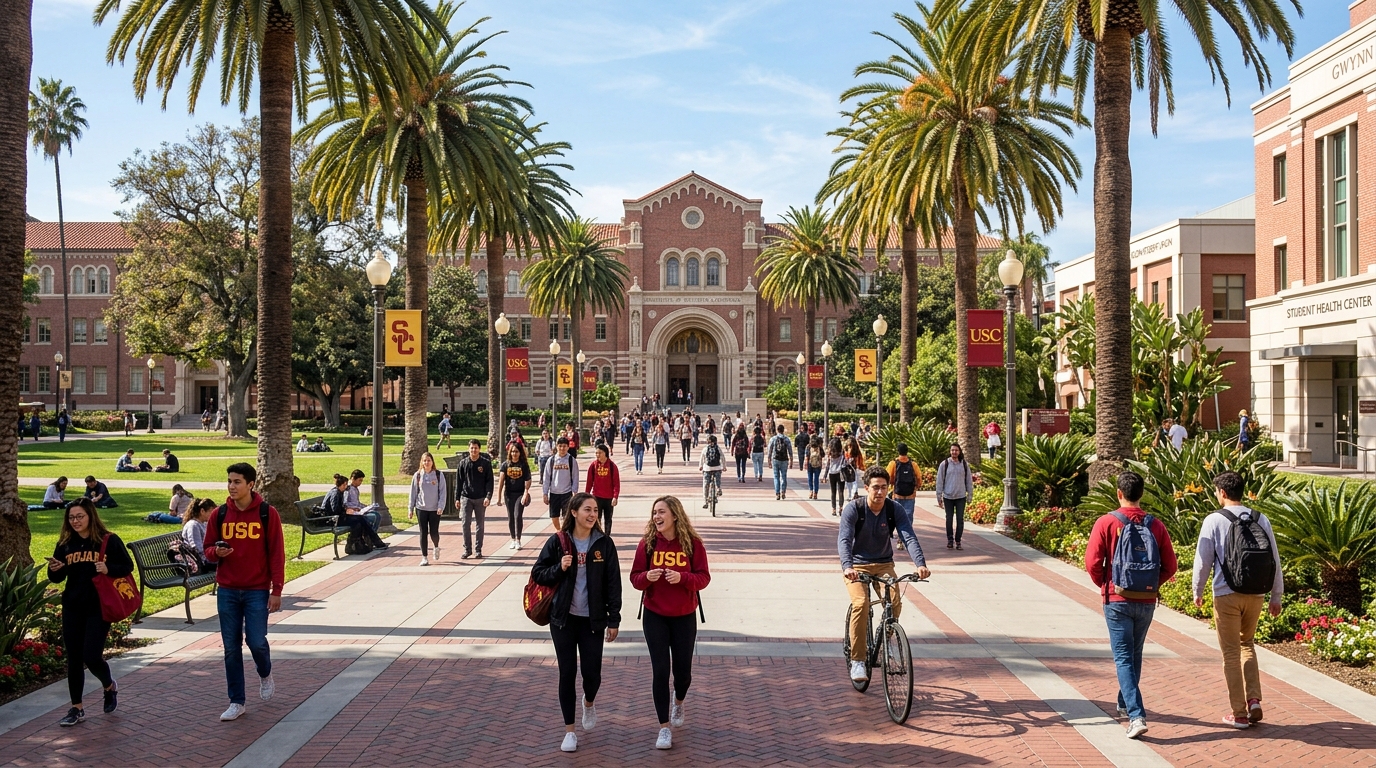
USC sits in the University Park neighborhood, roughly three miles south of downtown Los Angeles. The 226-acre campus is widely admired for its harmony of red-brick architecture and palm trees — a setting that captures the very essence of Southern California.
Notable Campus Landmarks
- Tommy Trojan Statue: USC’s iconic symbol.
- Doheny Memorial Library: the university’s central library.
- Alumni Park: a popular gathering and study space for students.
- Lyon Center: the university’s comprehensive recreation and athletics facility.
- Robert Zemeckis Center: the centerpiece facility for the School of Cinematic Arts.
Student Activities
USC supports more than 700 student clubs and organizations. Among the most active areas of student life are:
- Greek Life: approximately 22% of undergraduates participate.
- Student Government: undergraduate self-governance bodies.
- Cultural Organizations: a wide spectrum of identity- and heritage-based groups.
- Professional Societies: discipline-specific organizations tied to academic programs.
- Service Organizations: groups dedicated to community engagement and outreach.
Athletics (USC Trojans)
USC competes in NCAA Division I as a member of the Pac-12 Conference. The Trojans have a long tradition of excellence in football and swimming, and home football games at the Los Angeles Memorial Coliseum remain a defining cultural experience at USC.
Housing
USC strongly encourages first-year students to live on campus and offers a range of housing styles to fit different needs:
- Residential Colleges: themed living-learning communities.
- Traditional Residence Halls: standard dormitory-style housing.
- Apartments: apartment-style housing geared toward upperclassmen.
- Special Interest Housing: communities organized around shared interests.
7. Career Outcomes
| Indicator | Figure (2022) |
| Employed within 6 months of graduation | 89% |
| Continuing to graduate school | 15% |
| Average starting salary | $70,000–$75,000 |
| Median salary 10 years after graduation | $98,000 |
Top Employers and Industries
Technology and Media:
- Google, Apple, Microsoft, Amazon
- Netflix, Disney, Warner Bros., Sony Pictures
- Meta (Facebook), Snapchat, TikTok
Finance and Consulting:
- Goldman Sachs, Morgan Stanley, JPMorgan Chase
- McKinsey & Company, Boston Consulting Group
- Deloitte, PwC, EY, KPMG
Startups and Entrepreneurship:
- USC graduates have founded a wide range of successful startups.
- Their presence is especially strong in the tech startup ecosystems of Los Angeles and Silicon Valley.
| The Power of the Trojan Network: USC’s greatest asset is what alumni call the “Trojan Family” — a global network of more than 400,000 graduates. The culture of mutual support among Trojans is particularly strong in entertainment, technology, and business, where alumni actively open doors for one another throughout their careers. |
8. Five Common Misconceptions Among Korean Parents
Misconception 1: “USC is a party school where the academic atmosphere isn’t serious.”
The reality: USC is a research-intensive university with consistently high academic standards. While campus social life is undeniably active, that energy is best understood as part of a broader culture of networking and leadership development.
Misconception 2: “USC is only for wealthy families.”
The reality: USC operates one of the most generous financial aid programs in the country, and its student body reflects a wide range of economic backgrounds. For families earning under $80,000 per year, tuition is fully covered.
Misconception 3: “The area surrounding USC is unsafe.”
The reality: The campus itself is highly secure, and USC invests substantially in campus safety, including 24-hour security operations and an extensive shuttle service for students.
Misconception 4: “USC is only well known for its film school.”
The reality: USC offers top-tier programs across business, engineering, communication, public policy, and many other disciplines.
Misconception 5: “USC graduates can only find work in entertainment.”
The reality: USC alumni are active across virtually every industry — technology, finance, consulting, healthcare, and law — and are particularly well represented in senior leadership roles.
9. Five Distinctive Strengths of USC
① The Trojan Network
USC’s most valuable asset is its global network of more than 400,000 alumni. Guided by the motto “Once a Trojan, Always a Trojan,” USC has cultivated a culture in which graduates take active responsibility for opening doors for the students who follow them.
② A Hub for Industry Partnerships
USC leverages the strategic advantage of its Los Angeles location to maintain close working relationships with employers across Hollywood, Silicon Beach, and downtown Los Angeles — producing exceptional internship and recruiting opportunities for its students.
③ Interdisciplinary Education
USC has long championed interdisciplinary learning, offering innovative programs that bridge fields such as business and film, or engineering and the arts.
④ An Entrepreneurial Culture
USC places significant emphasis on entrepreneurship and actively supports student-led ventures, and many of its graduates have gone on to build successful companies of their own.
⑤ Global Reach
USC alumni are present in 140 countries, with a particularly robust presence across Asia. South Korea is home to a substantial and influential community of USC graduates.
10. Real Student Profiles
Case 1: Student S.K. (Admitted to Marshall School of Business)
Academic Record:
- GPA: 3.95 (Unweighted), 4.68 (Fully Weighted)
- SAT: 1520 (ERW: 750, Math: 770)
- AP Courses: 12 total — AP Calculus BC, AP Statistics, AP Economics (Macro/Micro), AP Psychology, AP U.S. History, AP World History, AP English Language, AP English Literature, AP Biology, AP Chemistry, AP Physics C
Four-Year Activity Profile:
- 9th Grade: Student Council Representative; Math Honor Society; Korean Culture Club
- 10th Grade: DECA (business competition); National Honor Society; JV Tennis Team
- 11th Grade: DECA State Officer; Varsity Tennis Team Captain; part-time job at a local business
- 12th Grade: Student Body President; DECA International Competition; founder of a Youth Business Mentorship Program
- Summer Activities: UCLA Business Summer Program (10th); Goldman Sachs Internship (11th)
- Community Service: 250 hours total (local senior center; Korean school tutoring)
Distinguishing detail: While in high school, the student worked with classmates to build a successful online tutoring platform that generated revenue, and then used those earnings to operate a free SAT preparation program for low-income students in the local community.
Case 2: Student J.L. (Admitted to the School of Cinematic Arts)
Academic Record:
- GPA: 3.88 (Unweighted), 4.45 (Fully Weighted)
- SAT: 1480 (ERW: 780, Math: 700)
- AP Courses: 9 total — AP English Literature, AP English Language, AP U.S. History, AP Art History, AP Psychology, AP Statistics, AP Calculus AB, AP Physics 1, AP Spanish Language
Four-Year Activity Profile:
- 9th Grade: School Newspaper; Drama Club; Photography Club
- 10th Grade: Film Club President; participant in regional film festival; Yearbook Editor
- 11th Grade: independent documentary project; intern at a local television station; winner at a national film festival
- 12th Grade: established the school’s first film production course; mentored underclassmen; served as a film festival judge
- Summer Activities: NYU Film Summer Program (10th); Sundance Film Festival Youth Program (11th)
- Community Service: 180 hours total (created documentaries capturing the life stories of seniors in a nursing home)
Distinguishing detail: During the COVID-19 pandemic, the student produced a documentary chronicling the experiences of isolated elderly community members. The film was broadcast by a local television station and earned awards at multiple youth film festivals. The applicant’s portfolio included three short films and five documentaries.
11. Grade-by-Grade Preparation Strategy
Middle School (Grades 6–8)
- Build a strong foundation in English reading and writing.
- Solidify core math skills through Algebra.
- Explore a range of activities to discover authentic interests.
- Begin developing leadership experience (e.g., class officer roles).
- Begin engaging in community service.
9th Grade (Freshman)
- Begin GPA management in earnest — aim for an A in every course.
- Begin enrolling in Honors-level courses.
- Commit to three to four meaningful extracurricular activities.
- Focus intensively on building English skills (the foundation for PSAT/SAT preparation).
- Summer: participate in an academic program or another substantive activity.
10th Grade (Sophomore)
- Take the first AP courses (one or two recommended).
- Take the PSAT to gauge current standing.
- Begin moving into leadership roles within extracurricular activities.
- Participate in a summer program connected to areas of interest.
- Visit the USC campus and attend an information session.
11th Grade (Junior) — The Most Important Year
- Maximize academic rigor by taking three to five AP courses.
- Engage in focused SAT/ACT preparation and testing (target: SAT 1500+).
- Step into leading positions in primary extracurricular activities.
- Summer: pursue an internship or research experience related to intended major.
- Build the college list and gather information specific to USC.
- Cultivate strong relationships with the teachers who will write recommendation letters.
12th Grade (Senior)
- Maintain the highest level of academic rigor with four to six AP courses.
- Retake the SAT/ACT if necessary.
- Prepare the USC application and supplemental essays with great care.
- Request recommendation letters by early September.
- November: submit Early Decision/Early Action applications.
- January: submit USC Regular Decision application (deadline: January 15).
12. Junior and Senior Year Checklists
11th Grade Checklist
- September: prepare for and take the PSAT/NMSQT.
- October: take SAT Subject Tests if required.
- December: take the SAT or ACT for the first time.
- January: attend a USC information session or campus tour.
- March: retake the SAT or ACT if needed.
- April: prepare for AP exams.
- May: take AP exams; finalize summer plans.
- June: take the final round of SAT/ACT testing.
- Summer: participate in major-related activities or a USC summer program.
12th Grade Checklist
- August: open a Common Application account; begin essay drafts.
- September: request recommendation letters; prepare official transcripts.
- October: complete USC essays; conduct a final review of the application.
- November: perform a final pre-submission check of the application.
- December: prepare the USC Regular Decision submission.
- January 15: USC Regular Decision deadline.
- February–March: submit any additional materials as needed.
- April: review admission decisions and make a final college choice.
- May 1: confirm enrollment and submit the deposit.
Conclusion: Who Is the Right Student for USC?
USC is best suited not simply to students with strong academic records, but to students whose character matches the spirit of the institution:
The Student Profile That Thrives at USC:
- Students who understand the value of networking — those who genuinely care about relationships and enjoy working with others.
- Students with creative, entrepreneurial instincts — those who want to bring innovative ideas to life.
- Students who embrace and enjoy diversity — those who want to grow within a multicultural community.
- Students who want both theoretical depth and practical skill — those seeking academic rigor alongside real-world application.
- Students who aspire to lead — those eager to guide teams and drive meaningful change.
Anchored by the unique sense of community known as the Trojan Family, USC offers an environment where students grow not only academically but also as individuals. For students who hope to build their futures in entertainment, technology, or business, USC provides one of the strongest possible launchpads.
In closing, gaining admission to USC requires excellent academic credentials as a baseline — but on top of that foundation, applicants must demonstrate a distinctive personal narrative, meaningful leadership experience, and the unique talents they will contribute to the USC community. With thoughtful, structured preparation and genuine passion, your child can absolutely become part of the Trojan Family.
| Elite Prep Suwanee — from SAT preparation to financial aid guidance, and access to AP and college-credit courses recognized by every U.S. university. This guide was brought to you by Suwanee Elite Academy. |
Andy Lee / Director of Elite Prep Suwanee powered by Elite Open School
Address: 1291 Old Peachtree Rd. NW #127, Suwanee, GA 30024
Phone / Text: 470.253.1004
Email: andy.lee@eliteprep.com
Website: www.eliteprep.com/suwanee