Dartmouth College – A Parent’s Guide to Your Child’s Successful Admission to a Top U.S. University
This column is written for Korean parents whose children are currently attending U.S. high schools and who aspire to admission to top-tier American universities. Because admissions data and policies may change from year to year, this article is based on generally available information and representative examples rather than guaranteed figures. We hope you will read this with ease and use it as a helpful reference in planning your child’s college journey.
Now, let us take a closer look at one of the Ivy League’s hidden gems: Dartmouth College.
1. Introduction
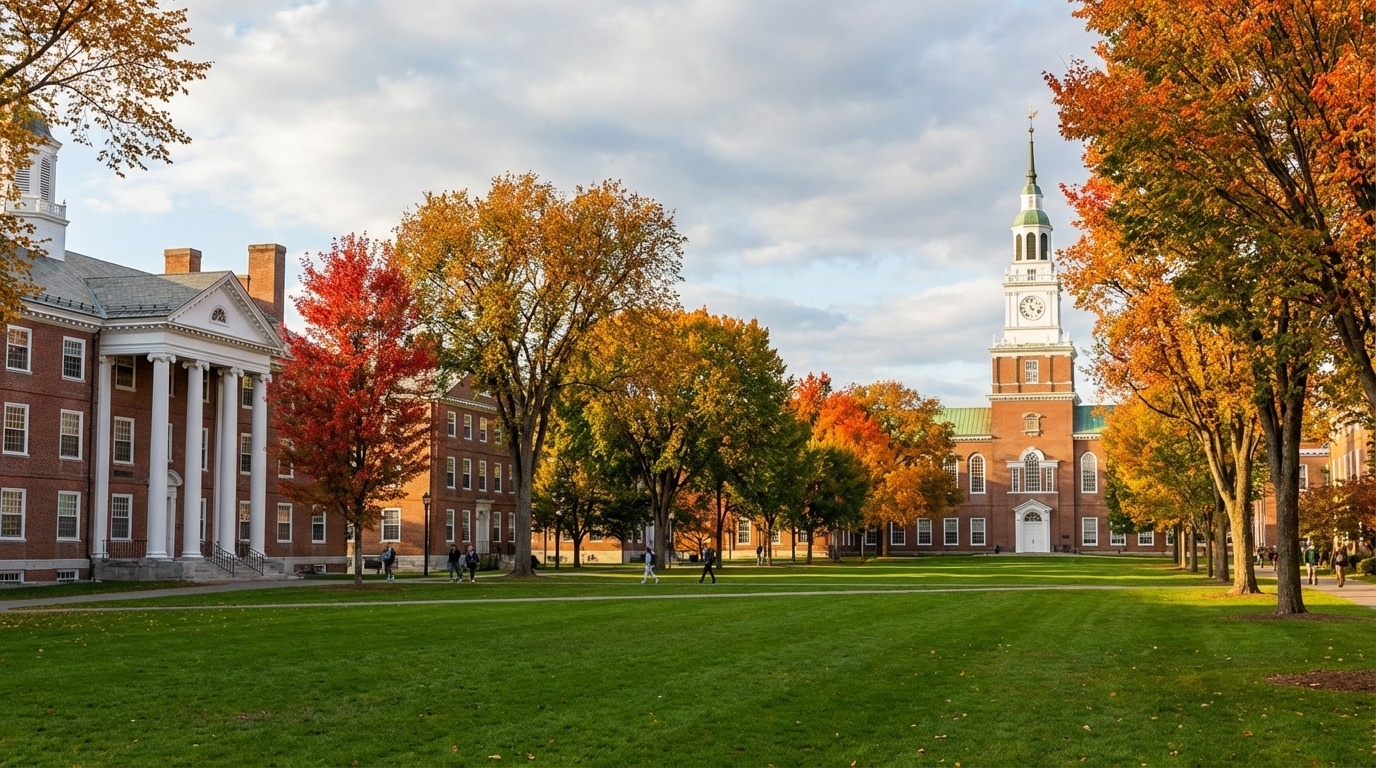
Dartmouth College is widely regarded as the Ivy League institution with the strongest undergraduate-focused educational model. Its close-knit academic environment encourages meaningful one-on-one interactions between professors and students, fostering deep intellectual engagement and collaborative research. Combined with a strong sense of community rooted in its beautiful natural surroundings, Dartmouth offers a truly distinctive educational experience.
If your child is considering Dartmouth as a target school, let us examine in detail how they should prepare.
2. Admissions Statistics and Application Requirements
a. Recent Admissions Data (Class of 2029 & 2028 Analysis)
- Total Applicants: 28,230
(approximately a 10.8% decrease from the previous year, influenced by the reinstatement of test requirements) - Total Admitted Students: Approximately 1,702
- Acceptance Rate: 6.03%
- Middle 50% SAT/ACT Scores of Admitted Students:
- SAT: 1500–1560
- ACT: 33–35
- High School Rank:
96% of admitted students ranked in the top 10% of their graduating class
b. Important Update: SAT/ACT Required
Beginning with the Class of 2029 (2026 admissions cycle), Dartmouth reinstated its test-required policy. Students applying to Dartmouth should plan to secure competitive SAT or ACT scores by 10th grade, or no later than 11th grade.
3. Factors Considered in Admissions Decisions
a. Academic Factors
Most Important
- Academic GPA
- Rigor of high school curriculum
- Standardized test scores (SAT/ACT)
Important
- Essays
- Letters of recommendation (teachers and school counselors)
b. Non-Academic Factors
Very Important
- Personal character and qualities
- Extracurricular involvement
Important
- Special talents
- Geographic diversity
- Legacy status (now reduced in influence, but still considered)
4. Academic Preparation
a. Recommended High School Curriculum
Dartmouth strongly encourages students to pursue the most challenging coursework available at their high schools.
- English: 4 years (with an emphasis on writing-intensive literature courses)
- Mathematics: 4 years (Calculus required for engineering-bound students)
- Science: 3–4 years (including laboratory-based physics, chemistry, and biology)
- Foreign Language: 3–4 years in a single language
- Social Studies/History: 3 or more years
b. Qualities Dartmouth Values Most
Dartmouth places exceptional value on intellectual curiosity. The admissions committee looks beyond high scores to identify students who actively ask questions, pursue learning independently, and demonstrate genuine academic passion beyond the classroom.
5. Extracurricular Activities and Leadership
a. Preferred Activity Profiles
- Outdoor & Community Engagement
Dartmouth highly values outdoor activities and community involvement. Participation in hiking clubs, environmental initiatives, or organizations such as the Boy Scouts reflects teamwork, resilience, and alignment with Dartmouth’s culture. - Peer-to-Peer Leadership
Rather than hierarchical leadership, Dartmouth favors students who demonstrate collaborative, horizontal leadership—those who grow alongside their peers and elevate others.
6. Sample Admitted Student Profiles
(Illustrative examples for reference only)
Profile A: STEM-Oriented Student
- GPA: 4.0/4.0 (Unweighted)
- Class Rank: 1 out of 350
- SAT: 1570 (Math 800)
- Activities:
President of Robotics Club, State-level environmental data analysis internship, Captain of varsity track team - Essay Theme:
Connecting childhood experiences of stargazing in a rural town to a deep interest in astrophysics
Profile B: Humanities/Social Sciences Student
- GPA: 3.96/4.0
- ACT: 35
- Activities:
Editor-in-Chief of school newspaper, State-level award winner in Model United Nations, Three-year commitment to ESL mentoring at a local multicultural center - Essay Theme:
The importance of listening, learned through friendships with immigrant peers from diverse linguistic backgrounds
7. Supplemental Essay Analysis (2025–26 Cycle)
Dartmouth’s supplemental essays are well known for emphasizing authenticity and personal values.
1. “Why Dartmouth?” (100 words)
Prompt:
As you seek admission to Dartmouth’s Class of 2030, what aspects of the college’s academic program, community, and/or campus environment attract your interest?
Strategy:
With only 100 words, precision is critical. Avoid generic praise. Reference specific elements—such as professors, research centers, or the unique D-Plan quarter system—to clearly explain why Dartmouth is the right fit for you.
2. “Introduction” Essay (250 words)
Options include:
- “Let your life speak…”
- “Be yourself…”
Strategy:
This essay invites you to share your background and identity beyond grades and test scores. Highlight a distinctive hobby, family experience, or personal trait. Essays that convey warmth and individuality—making the reader think, “This student would be a great roommate and classmate”—are particularly effective.
3. “Passion & Curiosity” Essay (250 words)
Options include multiple prompts focused on intellectual and personal passions.
Strategy:
What truly excites you? Whether it is an academic interest or a social cause, focus less on what you do and more on why you are deeply invested in it. Dartmouth values depth of passion over superficial involvement.
8. Grade-by-Grade Preparation Strategy
- Grades 9–10:
Build a strong academic foundation, maintain a high GPA, explore a wide range of clubs and interests, and cultivate reading habits. - Grade 11:
This is the most critical year. Increase AP or advanced coursework, finalize SAT/ACT scores, and pursue meaningful summer experiences such as research programs or academic camps aligned with your intended major. - Grade 12:
Focus intensively on essays. Dartmouth appreciates essays that feel human and sincere. Rather than striving for perfection, aim for honesty, reflection, and emotional authenticity.
9. Conclusion
Dartmouth is a small but powerful institution. From its forested campus, it nurtures students who go on to shape the world in meaningful ways. For students who love nature, value human connection, and enjoy thoughtful conversation, Dartmouth can be an exceptional choice.
This concludes our guide, brought to you by Andy Lee, Director of Elite Prep Suwanee, where we proudly provide free assistance with the Congressional Award and FAFSA.
Thank you.
If you have any questions regarding your child’s college planning, please feel free to contact us anytime.
Website: www.eliteprep.com/contact-us
Phone: 470.253.1004
Andy Lee
Elite Prep Suwanee, powered by Elite Open School
1291 Old Peachtree Rd, NW #127
Suwanee, GA 30024
Phone: 470.253.1004
Email: andy.lee@eliteprep.com
Website: https://is.gd/yt9rgu
YouTube: www.youtube.com/@andyssamTV