【Georgetown University】- The Complete Parent’s Guide to Admission & Financial Aid
April 2026
“Georgetown? I know it’s a great school, but my child isn’t really interested in politics or diplomacy — is it still worth applying?”
This is one of the most common questions I hear from parents during consultations. And my answer is always the same:
“Georgetown is not just a school for aspiring diplomats. But to take full advantage of everything Washington, D.C. has to offer, you’ll need a more deliberate strategy than you would for just about any other university.”
With over two decades of experience guiding Korean-American students through the U.S. college admissions process, I can tell you that Georgetown is one of the schools where your answer to “Why this school?” matters more than almost anything else. It’s also the only top-25 university that does not accept the Common Application — requiring all applicants to use its own proprietary portal.
This guide covers everything parents need to know about Georgetown — from admissions and financial aid to campus life and career outcomes. Read it from start to finish, and your child’s approach to this school will fundamentally change.
1. At a Glance
| Category | Details |
| Official Name | Georgetown University |
| Founded | 1789 (the oldest Jesuit and Catholic university in the United States) |
| Location | Washington, D.C. — Georgetown neighborhood |
| Campus | 104 acres overlooking the Potomac River |
| Undergraduate Enrollment | Approximately 7,500 |
| Total Enrollment | Approximately 20,000 (including graduate and professional schools) |
| Religious Affiliation | Roman Catholic / Jesuit (Society of Jesus) |
| Mascot | Jack the Bulldog — Georgetown Hoyas |
| School Colors | Blue & Gray |
Georgetown was founded in 1789 — before the United States itself had fully taken shape. It is not merely one of the oldest universities in America; it is an institution that has spent nearly 240 years educating leaders at the very heart of U.S. political, diplomatic, and legal power.
A notable piece of history: In 2019, Georgetown students voted to establish a reparations fund benefiting descendants of the 272 enslaved people sold by the university in 1838 to resolve a financial crisis. It was a landmark moment — a living example of the school’s deep commitment to social justice.
2. Rankings
Overall Rankings
| Ranking Organization | Position |
| U.S. News National Universities (2024–25) | Approximately 22–24 |
| QS World University Rankings (2025) | ~270–290 (Global) |
| Times Higher Education (2025) | ~251–300 (Global) |
On the surface, Georgetown appears to be “just a top-25 school.” But that number significantly underrepresents its actual prestige. Global ranking systems like QS and THE heavily weight research output — metrics that disadvantage a university focused on policy, law, and diplomatic practice rather than pure academic research.
Rankings by Field — This Is Where It Counts
| Field | Ranking |
| International Relations & Diplomacy (SFS) | #1–2 nationally and globally |
| Law School (GULC) | #14–20 nationally |
| Public Policy (McCourt) | Top 5 nationally |
| Political Science / Government (undergraduate) | Top 5 nationally |
| Business / MBA (McDonough) | #24–28 nationally |
The bottom line: Georgetown is not simply a “top-25 university.” In certain disciplines, it outranks Harvard and Yale. This is a distinction every parent should understand clearly.
3. Schools Within Georgetown
When applying to Georgetown, students do not apply to the university as a whole. They apply to a specific School (undergraduate college), each with its own acceptance rate, essay requirements, and evaluation criteria.
Walsh School of Foreign Service (SFS) — Georgetown’s Crown Jewel
Founded in 1919, the SFS is the oldest and most prestigious school of international affairs in the world, consistently ranked #1 or #2 alongside Johns Hopkins SAIS. Its alumni include President Bill Clinton, King Abdullah II of Jordan, former Afghan President Hamid Karzai, and King Felipe VI of Spain. Georgetown leads all U.S. universities in the number of graduates employed at the State Department, CIA, World Bank, IMF, and United Nations. The acceptance rate hovers around 10–12%, making it Georgetown’s most competitive school.
A note for parents: “My child isn’t interested in international relations — is SFS still a fit?” The SFS is not just for future diplomats. Students pursue paths in international business, international law, global finance, and international NGO work. However, without a compelling essay explaining “Why SFS specifically,” admission is virtually impossible.
Georgetown University Law Center (GULC)
The largest law school in the United States by enrollment (~2,300 students), GULC ranks #14–20 nationally, with particular strength in constitutional law, tax law, international law, and health law. Four sitting or recent U.S. Supreme Court Justices are Georgetown Law alumni: Chief Justice John Roberts, the late Justice Antonin Scalia, Justice Clarence Thomas, and Justice Neil Gorsuch. Its Supreme Court Moot Court program prepares nearly every attorney who argues before the Court each term. The D.C. location provides unmatched access to federal courts, Congress, the DOJ, and top-tier law firms.
Robert Emmett McDonough School of Business
Ranked #24–28 for its MBA program (Financial Times and Bloomberg place it within the top 30), with a median MBA starting salary of approximately $150,000–$165,000. Key strengths include finance, international business, consulting, and marketing. The undergraduate business program (BSB: Bachelor of Science in Business) is also highly competitive, with an acceptance rate around 12–14%.
McCourt School of Public Policy
A top-5 public policy graduate school nationally, with a curriculum directly connected to the federal government, think tanks, and international organizations. Graduates go on to work as congressional staffers, federal agency leaders, and policy experts at institutions like the World Bank, IMF, and major NGOs.
Georgetown University Medical Center
The medical school ranks approximately 50–60 nationally. Georgetown is home to the NCI-designated Lombardi Comprehensive Cancer Center — one of only about 70 such centers in the country. It also maintains a clinical partnership with MedStar Health, the largest healthcare system in the D.C. region.
Georgetown College (Liberal Arts)
The oldest school within Georgetown, founded alongside the university in 1789, and the academic heart of the institution. Its strengths lie in political science and government (top 5 nationally), economics, history, philosophy, and theology — all grounded in the Jesuit tradition of rigorous ethics and humanities education.
4. Admissions
Acceptance Rates
| School | Acceptance Rate (2024–25) |
| Walsh School of Foreign Service (SFS) | ~10–12% |
| McDonough School of Business | ~12–14% |
| Georgetown College (Liberal Arts) | ~13–15% |
| School of Nursing & Health Studies | ~15–18% |
| Overall Average | ~13–14% |
Admitted Student Profile
| Metric | Range |
| SAT (Middle 50%) | 1450 – 1560 |
| SAT Math | 720 – 790 |
| SAT EBRW | 720 – 770 |
| ACT (Middle 50%) | 33 – 35 |
| Average Unweighted GPA | ~3.9 / 4.0 |
| High School Class Rank | Top 5–10% |
| 6-Year Graduation Rate | 93–95% (among the highest nationally) |
Application Platform — This Is Critical
⚠ Georgetown does not use the Common Application.
It is the only top-25 university that exclusively uses its own application portal. The Common App, Coalition App, and QuestBridge are not accepted (with the sole exception of QuestBridge Match). A surprising number of students discover this too late. You must apply directly through Georgetown’s proprietary portal.
Application Deadlines
| Application Round | Deadline | Notes |
| Early Action (EA) | November 1 | Non-binding (no enrollment commitment upon acceptance) |
| Regular Decision (RD) | January 10 | — |
| Transfer | ~March 1 | — |
Georgetown does not offer Early Decision (ED). Because Early Action is non-binding, students who are accepted early can still compare offers from other schools and review financial aid packages before making a final commitment. Applying EA is strongly recommended.
Required Application Materials
Georgetown’s own online application; high school transcript; one counselor recommendation letter; two teacher recommendation letters; SAT or ACT scores; $75 application fee (or fee waiver).
Georgetown Essays — Among the Most Demanding in the Top 25
Georgetown requires more essays than virtually any other top-25 school. Key prompts include:
“Why Georgetown? Why this School?” — This is the single most important essay. A generic answer about Georgetown being “a great school” will not work. You must connect your specific goals to specific programs, professors, and resources within the School you’re applying to.
Additional essays cover intellectual curiosity, meaningful activities or experiences, background and identity (diversity), and school-specific prompts (e.g., SFS applicants address a global issue; Business applicants discuss career goals). Each essay ranges from 250 to 500 words, and applicants can expect to write five to seven essays in total.
From my experience in the field: The “Why Georgetown” essay is where the most applicants fail. Writing that the location is ideal or the school is well-known are red flags for admissions officers. What they want to see is this: “This specific program, this professor, this resource connects directly to my specific goals.” Demonstrating this level of specificity requires genuine research — a campus visit, faculty interviews, or deep engagement with Georgetown’s resources.
5. Cost & Financial Aid
2024–25 Annual Cost of Attendance
| Item | Amount |
| Tuition | ~$65,082 |
| Room & Board | ~$19,260 |
| Books & Miscellaneous | ~$3,200 |
| Total Cost of Attendance (COA) | ~$87,000–$88,000 |
Georgetown is among the most expensive universities in the United States. But do not let the sticker price mislead you.
Georgetown’s Financial Aid Policy
Four core principles:
① Need-Blind Admission (for U.S. citizens and permanent residents) — A family’s financial situation has absolutely no bearing on the admissions decision. Note: international students are evaluated on a need-aware basis.
② 100% of Demonstrated Need Met — Georgetown commits to covering the full demonstrated financial need of every admitted student.
③ No-Loan Policy — All financial aid is awarded as grants (free money that does not need to be repaid). Student loans are not included in aid packages.
④ The 1789 Scholarship — Families earning $65,000 or less per year receive full coverage of tuition, room, and board. The scholarship is named after the university’s founding year.
Estimated Aid by Family Income
| Annual Family Income | Estimated Aid |
| $65,000 or below | 1789 Scholarship: Full tuition + room & board |
| $65,000 – $125,000 | $50,000+ in annual grants |
| $125,000 – $200,000 | $30,000–$50,000 in annual grants |
| $200,000 – $250,000 | Partial support (reduced amount) |
| $250,000+ | Limited aid (likely full-pay) |
Average need-based grant: approximately $50,000–$55,000 per year. Approximately 40–45% of undergraduates receive need-based financial aid. For graduates who do borrow, average student debt is approximately $25,000–$30,000 — well below the national average.
Endowment: ~$3.0–$3.1 billion. While this is modest compared to Harvard ($50B+) and Yale ($40B+), Georgetown still maintains all four pillars of its aid policy: Need-Blind, 100% Need Met, and No-Loan. The endowment may be smaller, but the policy is world-class.
Financial Aid Application Requirements
| Document | School Code | Priority Deadline |
| FAFSA | 001781 | February 1 |
| CSS Profile | 1392 | February 1 |
Important: Even if you apply Early Action in November and receive an acceptance in December, the financial aid application deadline is February 1 and must be submitted separately. Missing this deadline could mean forfeiting your financial aid — even if you’ve already been admitted.
6. Campus Life
Location — The Power of Washington, D.C.
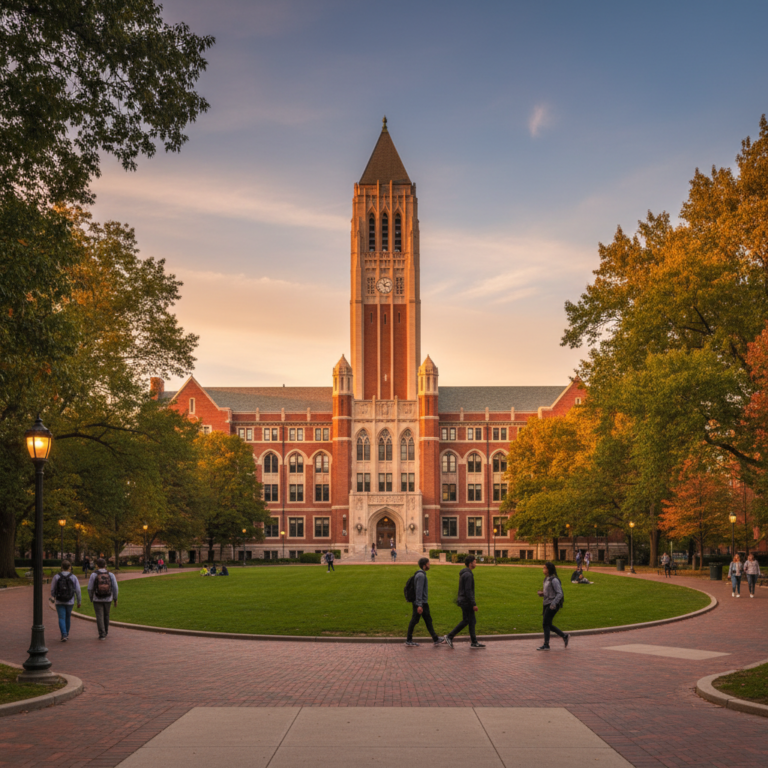
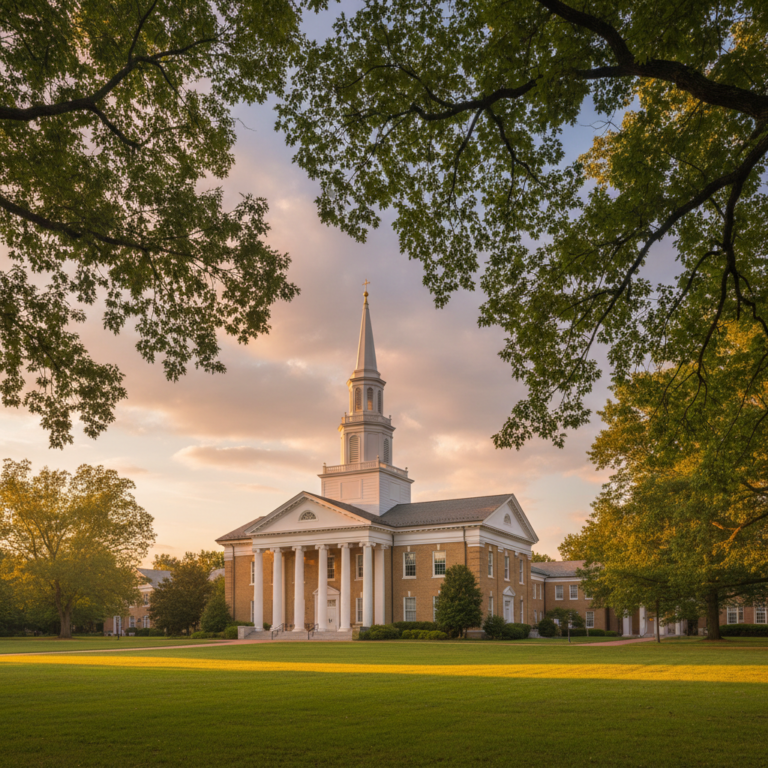
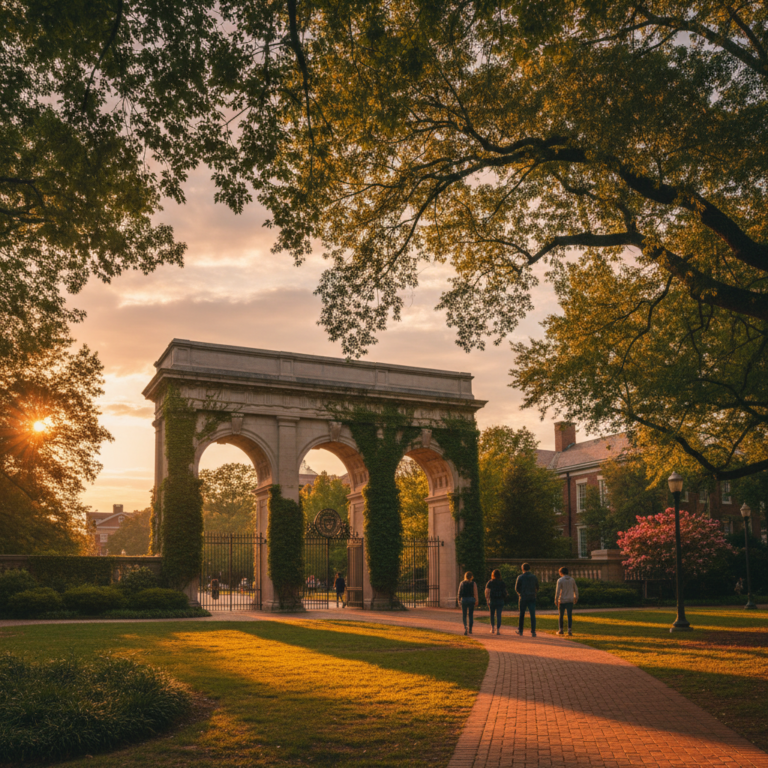
Georgetown’s campus sits atop a hill in the Georgetown neighborhood of northwest Washington, D.C., overlooking the Potomac River. The 104-acre campus blends historic architecture with the energy of the nation’s capital.
Practical advantages of the D.C. location:
The White House, State Department, and Capitol Hill are just a 15–20 minute drive away. The World Bank, IMF, UN Washington office, and the Embassy Row corridor are all nearby. World-class think tanks — Brookings, CSIS, the Council on Foreign Relations — are within walking distance. Federal internship opportunities are more accessible here than at any other university in the country. Cultural institutions such as the Kennedy Center, Smithsonian museums, and the National Mall are all at students’ doorstep.
A practical note: The Georgetown campus does not have its own Metro station. Students take a university shuttle to the nearest stop at Foggy Bottom–GWU. The Georgetown neighborhood is also one of the most expensive areas in D.C., so off-campus living costs tend to be high.
Key Buildings & Landmarks
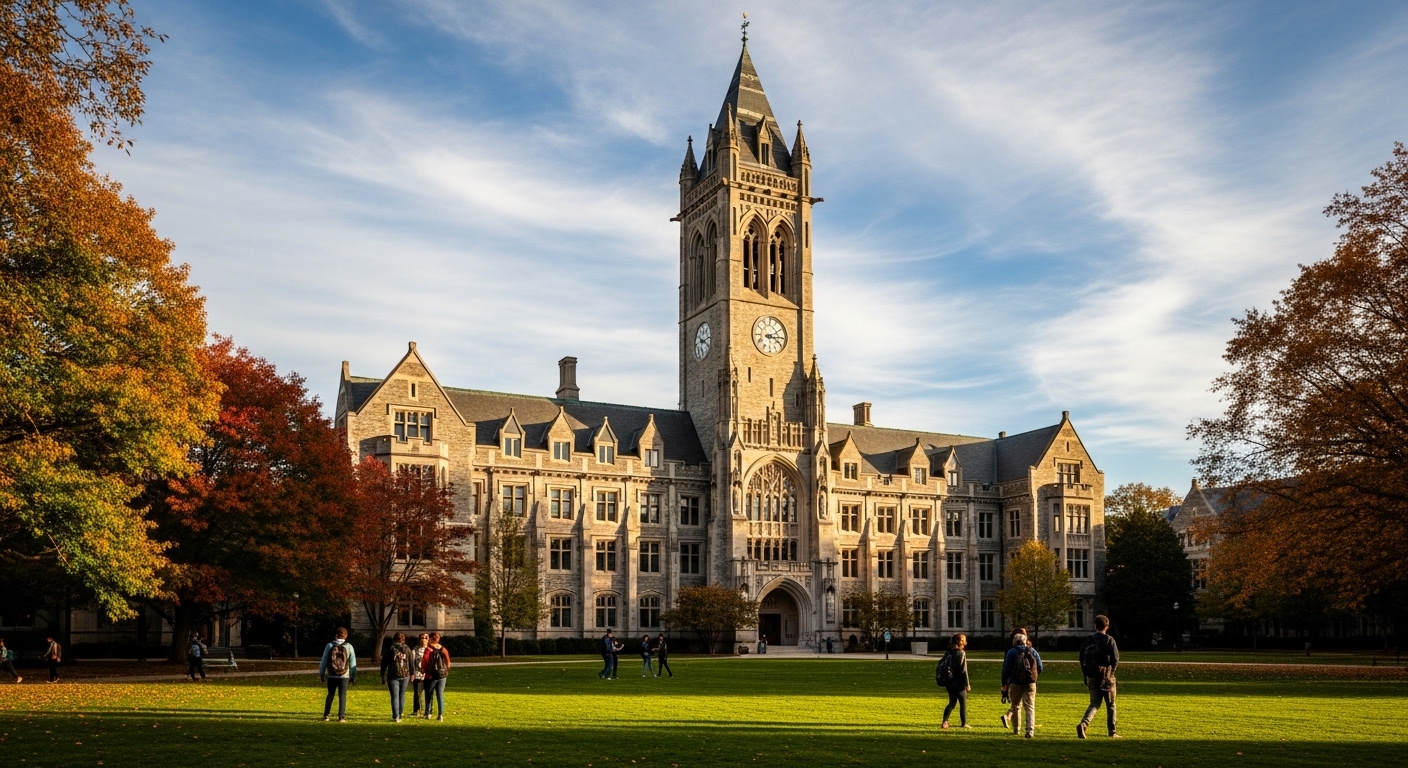
Healy Hall (1879): A Gothic clock tower and National Historic Landmark — the iconic symbol of Georgetown.
Gaston Hall: The grand auditorium inside Healy Hall, where U.S. presidents and world leaders have delivered addresses.
Old North (1795): The oldest building on campus; it served as a hospital during the Civil War.
The Exorcist Stairs: The filming location for the 1973 horror classic. Officially called the M Street Steps, they remain one of Georgetown’s most famous landmarks.
Lauinger Library: The main university library, notable for its distinctive Brutalist architecture.
Student Activities
More than 500 registered student organizations; the Georgetown Debate Team, consistently ranked among the best in the nation; The Corp, a student-run business operating cafes and convenience stores since 1971 — one of the largest student-run enterprises in the country; The Hoya (student newspaper) and WGTB (student radio); Campus Ministry supporting over 30 faith communities; and highly active political organizations including the Georgetown Political Union, College Democrats, and College Republicans.
Athletics — Georgetown Hoyas (NCAA Division I, Big East)
| Sport | Highlights |
| Men’s Basketball | 1984 NCAA Champions. Notable alumni: Patrick Ewing, Allen Iverson, Dikembe Mutombo, Alonzo Mourning |
| Men’s & Women’s Soccer | Consistently competitive in the Big East |
| Rowing | Strong tradition, with the Potomac River right at the campus doorstep |
| Lacrosse | Division I competitor |
Major home games are played at Capital One Arena in downtown D.C., not on campus.
Housing & Dining
On-campus housing is guaranteed for freshmen and sophomores. Primary freshman residence halls include Darnall Hall, New South Hall, Village C, LXR (Loyola/Xavier/Ryan), and Harbin Hall. Most juniors and seniors live off campus in the Georgetown neighborhood, where rents are notably high. The main dining hall is Leo’s (Leo J. O’Donovan Dining Hall), which operates on an all-you-can-eat basis. The Corp Cafe and Hoya Snaxa — both student-run — are a distinctive part of Georgetown’s campus culture.
7. Career Outcomes
Employment & Graduate School Placement Within 6 Months
| Population | Rate |
| Undergraduate (overall) | ~93–96% |
| McDonough MBA | ~97% |
Top Employers
Government & International Organizations (Georgetown’s Distinctive Strength)
U.S. State Department, CIA, National Security Council, Congress, and federal agencies; the World Bank, IMF, and UN-affiliated bodies; Brookings Institution, CSIS, and other leading think tanks.
Consulting & Finance
McKinsey & Company, BCG, Bain & Company; Goldman Sachs, JP Morgan, Morgan Stanley; Deloitte, PwC, EY, KPMG (Big 4).
Big Tech & Corporate
Amazon, Google, Microsoft.
Service & Nonprofit
Georgetown is consistently one of the top producers of Peace Corps volunteers in the United States.
Graduate & Professional School Placement
| Field | Georgetown Acceptance Rate |
| Medical School | ~55–70% (well above the national average of 40–44%) |
| Law School | Georgetown Law itself ranks #14–20 nationally |
| MBA | McDonough MBA acceptance rate: ~40–50% |
Fellowships & Scholarships: Georgetown consistently ranks among the top 10–15 producers of Fulbright Scholars nationally. It also regularly produces Rhodes and Marshall Scholars, particularly from SFS and Georgetown College.
Post-MBA Salary: McDonough MBA median starting salary: $150,000–$165,000. Undergraduate median starting salary: $65,000–$75,000 (varies significantly by major and industry).
8. Five Common Misconceptions Among Korean-American Parents
Misconception 1: “Georgetown is only for students interested in politics or diplomacy.”
The reality: While SFS is Georgetown’s most famous school, the university offers equally strong programs in liberal arts (Georgetown College), business (McDonough), medicine, and law. Students thrive here in economics, computer science, finance, marketing, and pre-med tracks.
Misconception 2: “An SAT score of 1550+ guarantees a safe admission.”
The reality: Far from it. Georgetown places significantly more weight on the depth and authenticity of essays and extracurricular activities than on standardized test scores. I have personally seen students with a 1580 SAT get rejected because their “Why Georgetown” essay lacked substance.
Misconception 3: “You can apply through the Common App.”
The reality: Georgetown does not accept the Common Application. All applicants must use the university’s own portal at uadmissions.georgetown.edu. Some families have missed their chance to apply entirely because they were unaware of this requirement.
Misconception 4: “Georgetown is a Catholic school, so students of other faiths are at a disadvantage.”
The reality: From its earliest days, Georgetown has welcomed students of all religious backgrounds. A significant portion of the current student body is not Catholic. Respect for religious diversity is central to the Jesuit educational philosophy.
Misconception 5: “Georgetown has a small endowment, so financial aid must be limited.”
The reality: Georgetown’s endowment (~$3B) is indeed smaller than Harvard’s or Yale’s. Yet the university maintains a Need-Blind admission policy, meets 100% of demonstrated need, and operates a No-Loan program. Families earning $65,000 or less receive full tuition, room, and board through the 1789 Scholarship.
9. What Sets Georgetown Apart
There is no other university in the United States quite like Georgetown. Here are the five defining characteristics that distinguish it from every other top-25 institution.
① Washington, D.C. as a Living Classroom
At most elite universities, students learn on campus and enter the professional world after graduation. At Georgetown, students serve as White House interns, congressional staffers, and State Department trainees while still enrolled. The line between theory and practice simply does not exist here.
② SFS — The Undisputed Leader in International Affairs
The Walsh School of Foreign Service is not merely a “strong program.” It is a 100-year-old institution that has functioned as the training ground for the world’s diplomats and international leaders. No other university on earth carries this brand.
③ An Unmatched Legal Network
With four Supreme Court Justices among its alumni, Georgetown Law’s network in the American legal system is rivaled only by Yale Law School.
④ Jesuit Education and Cura Personalis (Care for the Whole Person)
The Jesuit philosophy of Cura Personalis emphasizes education that goes beyond academic achievement to integrate ethics, service, and leadership. For families who value character development alongside intellectual growth, this tradition runs deep throughout every aspect of Georgetown’s curriculum.
⑤ A Truly Global Alumni Network
More than 230,000 alumni are spread across 180 countries. The “Hoya-to-Hoya” culture — Georgetown alumni actively supporting one another — is especially powerful in D.C., on Wall Street, and within international organizations.
10. Real Student Case Studies
Case 1: Ms. K — SAT 1510, Immigrant Family, SFS Acceptance
Ms. K immigrated to the United States from Korea in the sixth grade. With an SAT of 1510 and a GPA of 3.92, her academics were strong — but she initially felt she had “nothing special” in her extracurricular profile. Through our work together, we discovered a powerful story: she had spent five years interpreting for her parents, an experience that organically led her to become passionate about healthcare access for immigrant communities. She wrote three in-depth articles on the topic for her school newspaper. Her “Why SFS” essay connected this personal journey to Georgetown’s Institute for Women, Peace and Security by name. The result: Early Action admission to SFS.
Case 2: The L Family — $110,000 Annual Income, Effective Cost of $12,000/Year
The L family represented a typical Korean-American middle-class household with a combined income of $110,000. Their first reaction to Georgetown’s sticker price was to walk away. When we ran the numbers using Georgetown’s Net Price Calculator, the estimated annual grant came to approximately $52,000 — reducing the real out-of-pocket cost to roughly $35,000 per year. After submitting the FAFSA and CSS Profile accurately and promptly, the final aid package came in at $53,000 per year in grants. The total four-year cost was approximately $140,000 — comparable to what many families pay at an out-of-state public university.
11. Grade-by-Grade Preparation Strategy
Middle School (Grades 6–8)
Complete Algebra I or above by the end of 8th grade. Build strong English reading and writing habits (Georgetown places heavy weight on essays). Begin a second language — especially important for students considering SFS. Explore a range of activities broadly; the goal at this stage is discovering genuine interests, not accumulating titles.
9th Grade
Enroll in Honors-level courses or higher. Start a four-year foreign language sequence (essential for SFS applicants). Begin focusing on two to three core extracurricular activities. Start researching Georgetown: which School might be the right fit?
10th Grade
Begin taking one to two AP courses (maintaining As is non-negotiable). Take the PSAT 10. Invest deeply in core activities and begin positioning for leadership roles. A campus visit is highly recommended at this stage — it provides essential material for the “Why Georgetown” essay.
11th Grade
Take three to five AP courses (targeting 8–12 total by graduation). Take the SAT or ACT for the first time (March or May). Secure at least one leadership position (club president, team captain, or project lead). Identify and begin building relationships with two teachers for recommendation letters. Attend a Georgetown information session or virtual tour. Begin drafting the “Why Georgetown” essay.
12th Grade
August–September: Create an account on Georgetown’s application portal (not the Common App). September–October: Finalize all Georgetown essays and request recommendation letters. October: Submit FAFSA and CSS Profile (the deadline is February 1, but earlier is better). November 1: Early Action deadline — strongly recommended. January 10: Regular Decision deadline.
12. Junior & Senior Year Checklist
11th Grade Checklist
☐ Maintain As in 3–5 AP courses
☐ First SAT/ACT attempt (target: 1500+)
☐ Confirm which Georgetown School to apply to
☐ Secure at least one leadership position
☐ Complete a campus visit or attend a Georgetown information session
☐ Identify two teachers for recommendation letters
☐ Run Georgetown’s Net Price Calculator
☐ Draft the “Why Georgetown” essay
12th Grade Checklist
☐ Create Georgetown’s application portal account (September)
☐ Complete all Georgetown essays (September–October)
☐ Submit FAFSA (School Code: 001781)
☐ Submit CSS Profile (School Code: 1392)
☐ Submit Early Action application (November 1)
☐ Prepare Regular Decision backup (January 10)
Conclusion: Who Is Georgetown Right For?
Georgetown is not the right fit for every student. But if any of the following applies to your child, Georgetown may not just be a “good school” — it could be the best possible choice.
✓ A strong interest in international relations, diplomacy, or global policy
✓ Career aspirations in politics, government, public policy, or law
✓ A desire to gain hands-on experience in government and international organizations while still in college
✓ Goals in consulting, international finance, or global business
✓ A commitment to an education that emphasizes ethics and social responsibility
✓ The ambition to learn inside the “living classroom” of Washington, D.C.
A Final Word on Georgetown Admissions:
Your grades and test scores are the price of entry. The key that unlocks Georgetown’s door is your answer to “Why Georgetown?”
A student with a 1560 SAT will be rejected if that essay falls flat. A student with a 1480 SAT will be admitted if their goals are unmistakably aligned with Georgetown’s specific resources. I have watched this play out time and again over more than two decades in the field.
Whatever grade your child is in right now, if Georgetown is the dream — the time to start is today.
Thank you for reading.
From SAT preparation to financial aid strategy to accredited AP and college courses — Elite Prep Suwanee is here to guide your family every step of the way.
Andy Lee / Director of Elite Prep Suwanee powered by Elite Open School
Address: 1291 Old Peachtree Rd. NW #127, Suwanee, GA 30024
Phone/Text: 470.253.1004
Email: andy.lee@eliteprep.com
Website: www.eliteprep.com/suwanee
To schedule a free initial consultation, contact us by email or text. Please include your child’s current grade level, areas of academic interest, and target universities — this helps us provide the most accurate guidance from the very first conversation.