
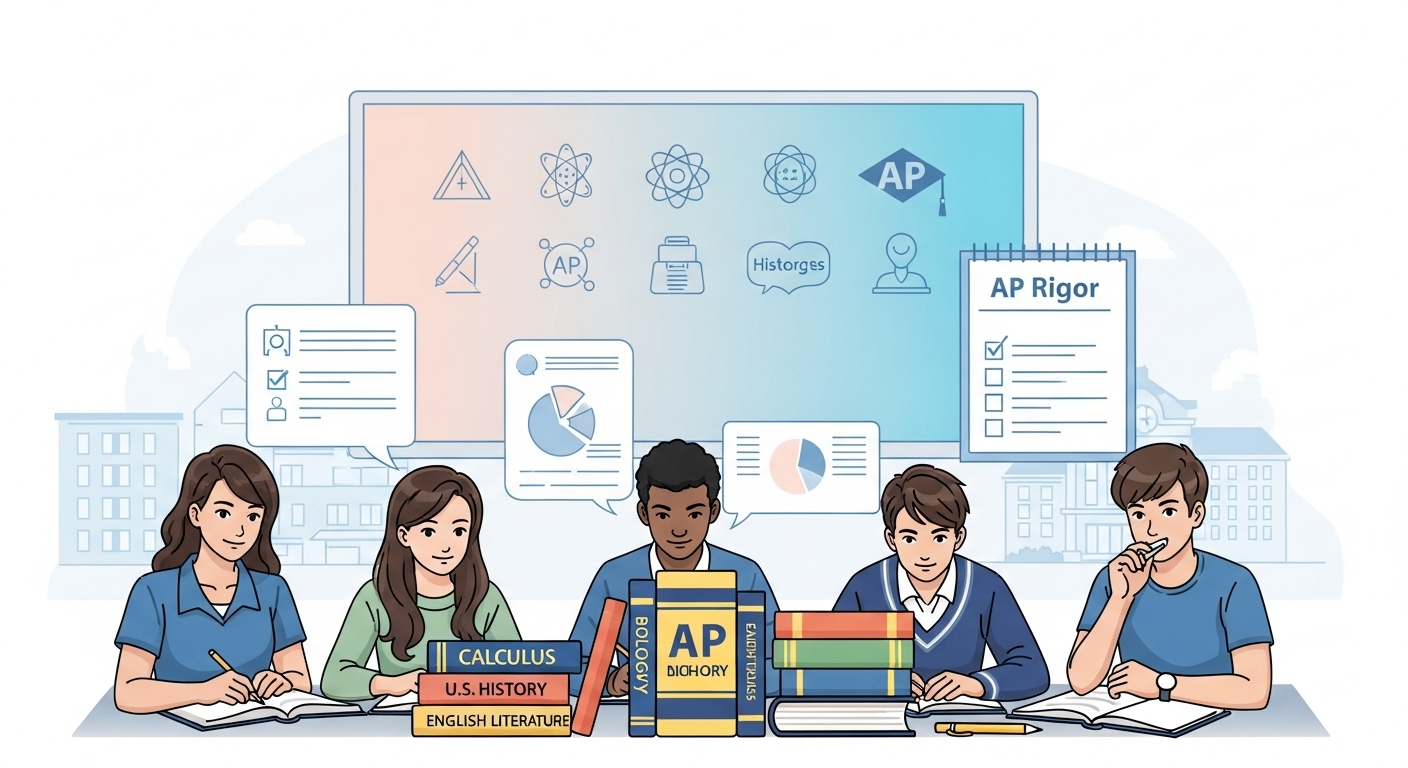
Understanding AP Course Rigor in College Admissions: A Comprehensive Guide for Parents
In the U.S. college admissions process, one of the most important factors—especially at competitive universities—is the level of academic challenge a student chooses throughout high school. Colleges don’t look only at grades; they also evaluate how rigorous the overall course load was, and whether the student pushed themselves appropriately in subjects that matter to them.
This guide summarizes the AP Course Rigor framework used widely in college counseling, helping parents understand what counts as “challenging,” how AP classes compare, and how students can build a well-balanced academic plan.
How Colleges Evaluate Rigor
1. Colleges look at a student’s full schedule—not individual classes
A student who takes one very difficult AP class but fills the rest of the schedule with easier courses may not present as strong a rigor profile. Admissions officers look for overall balance.
2. Students are not expected to take every class at the highest level
The best high school plan is one that reflects a student’s interests, strengths, and long-term goals. An effective schedule mixes very rigorous courses with moderately challenging ones.
3. Performance matters as much as rigor
Taking difficult classes is valuable, but earning strong grades in them is just as important. Colleges look at rigor and performance together.
AP Courses by Rigor Level
Below is a summary of AP subjects organized by their general level of difficulty. Individual experiences may vary depending on a student’s background and school environment.
Very Rigorous AP Courses
History & Social Science
- European History
- World History: Modern
- U.S. History
English
- English Language
- English Literature
Math
- Calculus AB
- Calculus BC
Science
- Biology
- Chemistry
- Physics C: Electricity & Magnetism
- Physics C: Mechanics
World Languages
- Spanish Language & Literature
- French Language
- Chinese, Japanese, German, Latin, Italian
Interdisciplinary
- AP Capstone Diploma (Seminar + Research)
Why These Matter:
These courses require strong analytical skills, significant study time, and mastery of college-level concepts. For STEM-oriented students, advanced math and science APs can be especially impactful.
Rigorous AP Courses
History & Social Science
- African American Studies
English
- Seminar
Math
- Computer Science A
- Statistics
Science
- Physics 1
- Physics 2
Arts
- Music Theory
Interdisciplinary
- Microeconomics + Macroeconomics
- Research
These classes still provide strong academic challenge but are generally more accessible than the highest-tier APs. They help build a well-rounded and credible schedule.
Somewhat Rigorous AP Courses
History & Social Science
- U.S. Government & Politics (1 semester)
- Comparative Government & Politics (1 semester)
- Human Geography
Math
- Precalculus
Science
- Computer Science Principles
- Environmental Science
Arts
- Studio Art (2D/3D/Drawing)
- Art History
Interdisciplinary
- Microeconomics (1 semester)
- Macroeconomics (1 semester)
- Psychology
These are excellent options for students new to AP coursework or looking to explore academic interests with manageable rigor.
Too New to Rate
Science
- Cybersecurity
Interdisciplinary
- Business Principles / Personal Finance
Because these courses were introduced recently, there is limited data to determine their rigor level. They can still be great choices based on interest.
How to Build a Strong AP Plan
1. Aim for a balanced schedule
For a STEM-focused student, this might mean taking highly rigorous math and science APs while selecting moderate-rigor humanities courses.
2. Increase rigor as students progress
A reasonable pathway might look like:
- 9th–10th grade: Mostly Somewhat Rigorous courses
- 11th grade: Mix of Rigorous + Very Rigorous
- 12th grade: Continue with an advanced but manageable combination
3. Choose AP subjects aligned with true interests
Admissions officers appreciate when a student’s schedule reflects real curiosity or passion—not just a desire for more AP labels.
4. Avoid excessive overload
Too many difficult APs can lead to burnout or declining grades. The goal is a healthy balance.
Final Thoughts
AP selection is not simply a checklist for college applications—it is an opportunity for students to discover their academic strengths, challenge themselves responsibly, and prepare for future study.
If you would like a personalized AP plan for your child, I would be happy to help.
Sharing your child’s grade level, intended major, favorite subjects, and academic strengths can provide a strong starting point.
Thank you so much.
If you need personalized guidance, I’m here to help.
📞 470-253-1004
📧 andy.lee@eliteprep.com
🌐 Elite Prep Suwanee Website
🌐 Elite Open High School Website
🎥 www.youtube.com/@andyssamTV
Andy Lee
Elite Prep Suwanee powered by Elite Open School
1291 Old Peachtree Rd, NW #127
Suwanee, GA 30024

![[Announcement] Upcoming AP Capstone Webinars – Thursday, June 19 & Saturday, June 21](https://elite4usa.com/wp-content/uploads/2025/06/06172025-2-768x430.png)