
The Ultimate Parent’s Guide to Financial Aid at the University of Pennsylvania (UPenn)
Hello! For parents dreaming of sending their children to the University of Pennsylvania (UPenn)—a world-class Ivy League institution famous for its prestigious Wharton School—I have compiled a comprehensive guide to understanding their financial aid system from an expert’s perspective.
UPenn is known for its academic excellence, but it is also known for its high price tag. However, it is equally renowned for having “one of the most generous financial aid policies in the United States.”
In this guide, I will walk you through the admissions and tuition overview, UPenn’s specific financial aid policies (Need-blind vs. Need-aware), application procedures and deadlines, expected aid amounts, net price calculations, and real-world case studies.
I hope this guide serves as a reliable compass on your journey to balancing your child’s dreams with your family’s financial reality.
Overview of Admissions and Cost of Attendance
As an Ivy League university, UPenn has extremely high admissions standards, but its financial support system is equally robust.
First, let’s look at the costs. For the 2025-2026 academic year, the total Cost of Attendance (COA) is estimated to be approximately $95,612. This includes Tuition (~$63,204), Fees (~$8,032), Housing (~$13,132), and Dining (~$6,744), as well as estimates for books, transportation, and personal expenses.
With a price tag exceeding $95,000 per year, it is completely natural for parents to feel a significant burden.
However, UPenn holds a strong principle that “a student’s financial circumstances should not prevent them from accessing a Penn education.” Their admissions policy supports this:
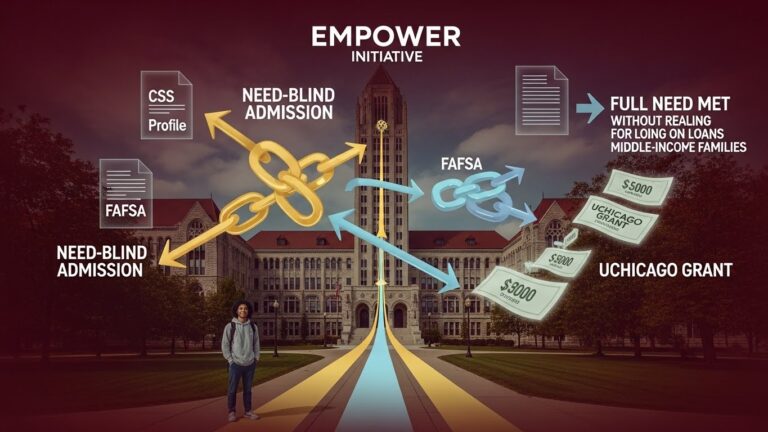
- Students from the U.S., Canada, and Mexico: UPenn practices a Need-blind policy. This means your family’s financial situation is not considered during the admissions process. Applying for aid will not disadvantage your child’s chances of acceptance.
- International Students (outside North America): UPenn applies a Need-aware policy due to limited funding. This means that for international students requiring significant financial assistance, the admissions process may be more competitive.
Crucially, regardless of citizenship or admissions policy, once a student is admitted, UPenn commits to meeting 100% of their demonstrated financial need.
UPenn’s Financial Aid Policy: Need-Based 100%, Grant-Based (No Loans)
The core of UPenn’s financial aid philosophy is the commitment to helping students “graduate debt-free.”
- Need-Based Only (No Merit Scholarships): Following Ivy League regulations, UPenn does not offer Merit-based scholarships for athletics or academic excellence. All aid is awarded strictly based on your family’s financial need.
- Grant-Based Policy (No Loans): One of UPenn’s greatest strengths is that its financial aid packages do not include student loans. The aid consists entirely of Grants (free money that does not need to be repaid) and Work-Study opportunities. This allows students to focus on their studies without the stress of accumulating debt.
- 100% Need Met: UPenn covers 100% of the difference between the total cost of attendance and your family’s calculated contribution (EFC).
Thanks to these policies, about 45% of UPenn undergraduates receive financial aid, with the average package amounting to $70,552—a sum that covers more than the cost of tuition alone.
How to Apply: Required Forms and Procedures
To receive aid, submitting the correct documents by the deadline is critical. The process differs slightly for domestic and international applicants.
1. U.S. Citizens/Permanent Residents & Students from Canada/Mexico
To be considered for both federal and institutional aid, you must submit:
- FAFSA (Free Application for Federal Student Aid): Required for U.S. citizens and permanent residents.
- CSS Profile: A College Board form used by private universities to assess detailed family financials (assets, expenses, etc.).
- Tax Documents: Copies of parent and student federal tax returns and W-2 forms must be submitted via the IDOC system.
2. International Students
International students are eligible for aid but must apply at the time of admission.
- CSS Profile: Since international students cannot file FAFSA, the CSS Profile is the primary document.
- Income Verification: You must submit translated tax returns or income statements from your home country. (Canadian students have a specific procedure for submitting Canadian tax documents).
- Important Note: If you do not apply for financial aid when you first apply for admission, you cannot apply for aid in subsequent years (unless there is an extreme, unforeseen change in financial circumstances).
3. Deadlines (2025-2026 Academic Year)
Do not miss these dates:
- Early Decision (ED): Early to mid-November (Submit by Nov 1–15 is recommended).
- Regular Decision (RD): By February 1st.
How is Financial Aid Calculated?
UPenn uses a systematic formula: Total Cost of Attendance (COA) – Expected Family Contribution (EFC) = Financial Need.
Your EFC is calculated based on income, assets, family size, and the number of children currently in college. UPenn has recently expanded benefits significantly for middle- and low-income families.
Projected Benefits by Income Bracket (2025-2026)
UPenn has expanded support through its “Quaker Commitment” initiative:
- Families earning under $75,000:
- Full Ride: You will likely receive a package covering Tuition, Fees, Housing, and Dining.
- Additional perks may include funding for summer internships/research, a laptop, and health insurance coverage.
- Families earning $75,000 – $200,000:
- Full Tuition Coverage: If you have typical assets, you are guaranteed a scholarship that covers at least full tuition (approx. $63,000+).
- The family would typically only be responsible for housing and dining costs.
- Families earning over $200,000:
- Even high-income families can receive aid if they have multiple children in college or other special financial circumstances. Do not assume you won’t qualify.
New for 2025: UPenn has decided not to include home equity (primary residence) in their financial aid calculation. This is huge news for families who are “house rich but cash poor.”
Case Studies: Sending Your Child to UPenn
Let’s look at hypothetical scenarios to see how this works in practice.
- Case 1: The Kim Family (Middle Income: $120,000)
- Scenario: Family of 4, one child admitted to UPenn. Assets include one home and modest savings.
- Result: Under the new policy (<$200k), they receive a scholarship covering full tuition ($63,204).
- Net Cost: The family pays approximately $25,000 (Housing & Dining). This is comparable to, or even cheaper than, many public universities.
- Case 2: The Lee Family (Low Income: $60,000)
- Scenario: Family of 4, minimal assets.
- Result: Classified as “Highly Aided.” They receive a full grant covering Tuition, Housing, Dining, and Fees ($95,612).
- Net Cost: $0. Plus, the student receives a laptop and summer funding.
- Case 3: The Park Family (High Income: $250,000)
- Scenario: High income, but they have two children in college simultaneously.
- Result: Because they are paying two tuitions, UPenn may offer a grant of $15,000–$20,000 per year.
- Lesson: Always apply if you have multiple children in college, even with a high income.
Key Takeaways for Parents
- Trust the “Need-Blind” Policy (US/Canada/Mexico): Applying for aid does not hurt your admission chances. Always apply to reduce your burden.
- International Strategy: For students outside North America, admissions is Need-aware. However, since you cannot apply for aid later if you don’t apply now, you should apply if you genuinely cannot afford the full cost.
- Watch the Deadlines: Nov 1-15 for ED, Feb 1 for RD. Late applications can result in reduced aid.
- Leverage the “Grant-Based” Policy: UPenn offers Grants, not loans. This is the gold standard for graduating debt-free.
- Use the Net Price Calculator: Visit the UPenn admissions website or use MyIntuition to get a personalized estimate before applying.
- Home Equity Exclusion: Starting in 2025, your primary home value is excluded from calculations. Do not disqualify yourself based on your home’s value.
Conclusion
The University of Pennsylvania operates on the firm belief that “finances should never be a barrier to education.” While a $95,000 price tag is daunting, UPenn’s powerful financial aid system lowers that wall into a stepping stone.
If your child has worked hard enough to knock on UPenn’s door, put your financial worries aside for a moment and apply. With careful preparation and the right information, a world-class education is accessible to everyone, regardless of economic background.
I sincerely hope this guide helps open the door to a bright future for your child. Thank you!
For more detailed consultation on education and financial aid: 📞 470.253.1004 or www.eliteprep.com/contact-us
We offer personalized strategies tailored to your student’s unique situation.
Andy Lee / Elite Prep Suwanee powered by Elite Open School
1291 Old Peachtree Rd, NW #127
Suwanee, GA 30024
Website: Elite Prep Suwanee Website
Email: andy.lee@eliteprep.com Tel & text: 470.253.1004
🎥 www.youtube.com/@andyssamTV